
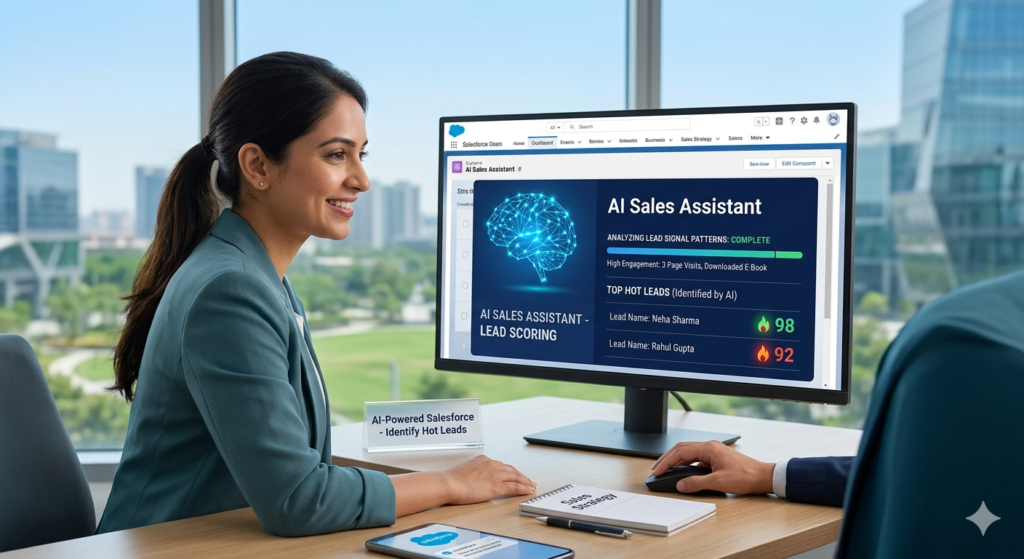
Every sales team has the same challenge — too many leads, but not enough time to follow up with all of them properly. Some leads are genuinely interested and ready to buy, while others are just browsing or filling forms without any real intent. The biggest problem is that sales reps often spend hours chasing cold leads while hot opportunities quietly slip away.
This is where an AI Sales Assistant inside Salesforce can completely change the game.
Instead of manually checking lead activity, notes, emails, and engagement history, AI can analyze everything automatically and tell your sales team which leads deserve immediate attention. It works like a smart assistant that continuously studies customer behavior and highlights the leads most likely to convert.
Why Traditional Lead Management Fails
In many companies, lead assignment still happens using simple rules like geography, industry, or round-robin distribution. While these methods are easy to set up, they don’t actually tell whether a lead is serious or not.
Imagine this situation:
One lead downloaded three case studies, visited your pricing page twice, opened multiple emails, and booked a demo.
Another lead only filled out a contact form once.
Both leads may look similar in Salesforce if your system is not analyzing behavior deeply. As a result, sales reps may spend equal effort on both leads, which is inefficient.
This is exactly where AI becomes valuable.
AI doesn’t just store lead data — it understands patterns, predicts intent, and prioritizes leads intelligently.
What Is an AI Sales Assistant in Salesforce?
An AI Sales Assistant is a smart automation system built inside Salesforce that helps sales teams make better decisions.
It can:
- Identify high-intent leads
- Predict conversion chances
- Recommend next actions
- Analyze customer engagement
- Send smart alerts to SDRs and sales reps
- Reduce manual lead qualification work
The assistant continuously studies customer activity from different sources like:
- Website visits
- Form submissions
- Email opens
- Demo requests
- CRM activity
- Previous buying behavior
- Marketing engagement
Based on this data, it calculates which leads are “hot” and should be contacted immediately.
How AI Identifies Hot Leads
The real power of AI comes from pattern recognition.
Instead of relying on one action, AI looks at multiple signals together.
For example:
A lead who:
- Visited the pricing page
- Opened 5 emails
- Clicked product links
- Downloaded a brochure
- Replied to a campaign email
…is probably more interested than someone who only subscribed to a newsletter.
AI analyzes these activities and assigns a lead score automatically.
The higher the score, the hotter the lead.
This helps sales reps focus only on leads that actually matter.
Building an AI Sales Assistant in Salesforce
Let’s understand how businesses can build this inside Salesforce.
Step 1: Capture Lead Activity Data
First, you need data.
Salesforce should collect engagement details from multiple channels like:
- Website forms
- Marketing campaigns
- Email platforms
- Live chat tools
- Customer interactions
- Social engagement
The more behavioral data AI receives, the more accurate its predictions become.
Many businesses integrate Salesforce with tools like:
- Marketing Cloud
- HubSpot
- Mailchimp
- LinkedIn Ads
- Google Analytics
This creates a complete lead activity timeline.
Step 2: Create Lead Scoring Logic
Now comes the intelligence layer.
You can create AI-based lead scoring using:
- Salesforce Einstein Lead Scoring
- Predictive AI models
- Custom Apex logic
- Machine Learning integrations
Different activities can carry different scores.
For example:
| Activity | Score |
|---|---|
| Opened Email | +5 |
| Clicked Product Link | +10 |
| Downloaded Pricing PDF | +20 |
| Requested Demo | +50 |
| No Activity for 30 Days | -15 |
This helps Salesforce automatically prioritize leads.
Step 3: Build Smart Recommendations
The next step is making the assistant useful for SDRs.
Instead of only showing scores, the AI assistant can suggest actions like:
- “Call this lead today”
- “Send pricing details”
- “Schedule demo follow-up”
- “High buying intent detected”
- “Lead becoming inactive”
These smart suggestions save time and improve response speed.
And in sales, speed matters a lot.
Studies consistently show that leads contacted quickly have much higher conversion rates.
Step 4: Create Real-Time Alerts
One of the best features of an AI Sales Assistant is instant notifications.
Imagine a lead suddenly:
- Visits your pricing page
- Opens multiple emails
- Revisits your website late at night
Your sales rep immediately receives a Salesforce notification saying:
“Hot Lead Alert: High engagement detected from ABC Company.”
This allows the sales team to take action at the perfect moment.
Timing can often decide whether a deal is won or lost.
Using Salesforce Einstein for AI Lead Scoring
Salesforce already provides AI capabilities through Salesforce Einstein.
Einstein can analyze historical CRM data and identify patterns from previously converted leads.
It studies things like:
- Industry
- Company size
- Engagement behavior
- Purchase history
- Email interactions
Then it predicts which new leads are most likely to convert.
The biggest advantage is that sales teams don’t need to manually calculate scores anymore.
Everything becomes automated and data-driven.
Benefits of an AI Sales Assistant
Better Sales Productivity
Sales reps stop wasting time on cold leads and focus only on high-value opportunities.
Faster Response Time
Hot leads receive immediate attention, improving conversion chances.
Improved Lead Conversion
AI helps teams contact the right people at the right time.
Reduced Manual Work
Automated scoring and recommendations reduce repetitive tasks.
Smarter Decision-Making
Instead of guesswork, decisions are based on real customer behavior.
Real-World Example
Let’s say a SaaS company receives 2,000 leads every month.
Without AI:
- SDRs manually review leads
- Many hot prospects are missed
- Follow-ups happen too late
After implementing an AI Sales Assistant in Salesforce:
- AI automatically scores every lead
- SDRs see top-priority leads first
- Hot leads receive calls within minutes
- Conversion rates improve significantly
This is why more businesses are now investing in AI-driven CRM systems.
Future of AI in Salesforce Sales
AI in Salesforce is evolving very fast.
In the future, AI Sales Assistants may:
- Write personalized emails automatically
- Predict deal closure probability
- Suggest the best meeting time
- Analyze customer sentiment from calls
- Generate sales summaries instantly
- Recommend upsell opportunities
Instead of replacing sales teams, AI will act like a smart co-pilot that helps them work faster and smarter.
Final Thoughts
Creating an AI Sales Assistant in Salesforce is no longer something only large enterprises can do. Businesses of all sizes are now using AI to improve lead qualification, reduce manual effort, and close deals faster.
The biggest advantage is simple — your sales team spends less time guessing and more time selling.
When AI identifies hot leads automatically, SDRs can focus their energy on prospects that actually matter. That leads to better productivity, faster conversions, and stronger customer relationships.