
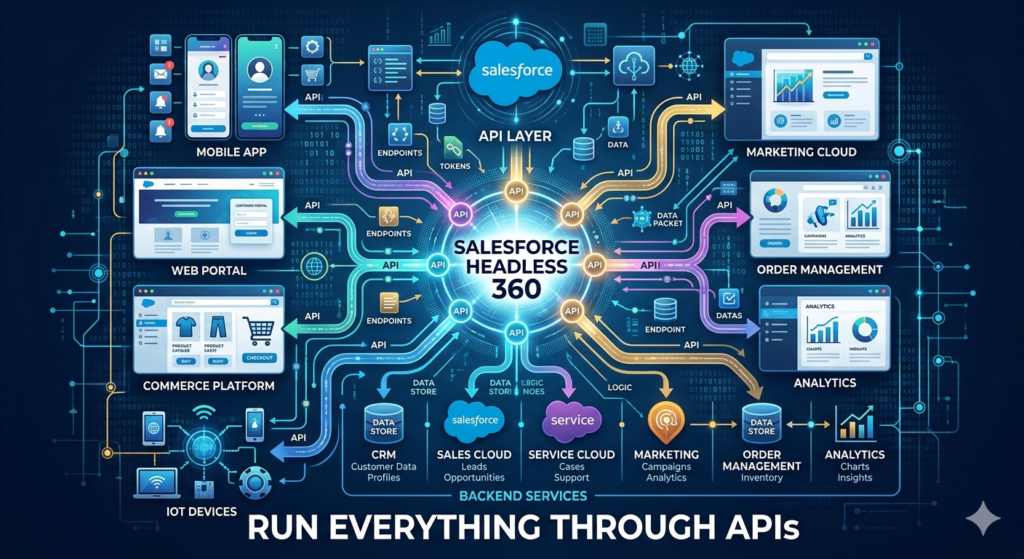
The way businesses build digital experiences is changing rapidly. Customers no longer interact with companies through a single website or application. Today, users connect through mobile apps, websites, chatbots, smart devices, social media platforms, and many other channels. Because of this shift, organizations need a flexible system that can deliver data and services anywhere, anytime. This is where Salesforce Headless 360 comes into the picture.
Salesforce Headless 360 allows businesses to separate the front-end experience from the back-end Salesforce platform. Instead of relying on traditional Salesforce user interfaces, developers can access Salesforce data and business processes directly through APIs. This approach gives companies complete freedom to create custom experiences while still using Salesforce as the central source of truth.
What is Salesforce Headless 360?
In a traditional Salesforce implementation, users interact with data through Salesforce pages, Lightning Components, or Experience Cloud sites. With a headless approach, the user interface is completely independent from Salesforce.
Think of Salesforce as the engine of a car. The engine does all the important work, but the design of the car can be customized based on requirements. Similarly, Salesforce manages data, automation, workflows, and business logic, while developers build unique front-end experiences using modern technologies such as React, Angular, Vue, mobile applications, or even IoT devices.
Everything is connected through APIs, allowing systems to communicate seamlessly without being tied to a specific user interface.
Why Businesses Are Moving Towards Headless Architecture
Modern customers expect fast, personalized, and consistent experiences across every channel. Traditional systems often struggle to meet these expectations because they are tightly connected to a single interface.
Headless architecture solves this challenge by allowing businesses to create experiences tailored for different platforms while maintaining centralized data management within Salesforce.
For example, an e-commerce company may have a website, a mobile application, a customer support chatbot, and a partner portal. Instead of building separate business logic for each platform, Salesforce can handle all the core processes while APIs deliver the required information to every channel.
This approach improves flexibility, scalability, and customer experience.
How APIs Power Salesforce Headless 360
APIs are the foundation of every headless architecture. They act as bridges that allow external applications to communicate with Salesforce.
Using Salesforce APIs, developers can create, update, retrieve, and delete records without accessing the Salesforce user interface. APIs can also trigger flows, automate business processes, fetch reports, manage customer data, and integrate external applications.
For example, a customer using a mobile app can place an order. The application sends data through Salesforce APIs, which create records, trigger automation, and update inventory. The customer never interacts directly with Salesforce, but Salesforce handles everything behind the scenes.
This creates a smooth and efficient experience for both customers and businesses.
Benefits of Salesforce Headless 360
One of the biggest advantages of Headless 360 is flexibility. Developers are free to choose any technology stack for building user experiences. They are not limited to Salesforce-specific UI frameworks.
Performance also improves because front-end applications can be optimized independently from the Salesforce backend. This allows faster page loading times and better responsiveness for users.
Another major benefit is scalability. As businesses grow and add new channels, they can reuse the same Salesforce backend and APIs without redesigning their entire architecture.
Headless architecture also supports innovation. Organizations can quickly launch new digital experiences without waiting for major backend changes.
Real-World Example
Imagine a retail company selling products online. Customers can browse products through a website, mobile app, or voice assistant.
Instead of maintaining separate databases and business logic for each platform, Salesforce stores all product, customer, and order information. APIs provide this information to every channel.
When a customer places an order through the mobile app, Salesforce automatically creates the order record, updates inventory, sends confirmation emails, and triggers fulfillment processes. If the customer later contacts support through a chatbot, the same Salesforce data is available instantly.
This creates a connected experience across all touchpoints.
Key Salesforce APIs Used in Headless Solutions
Salesforce provides several APIs that support headless architecture.
The REST API is widely used for lightweight integrations and mobile applications. It provides simple access to Salesforce data and services.
The GraphQL API helps developers retrieve multiple data objects in a single request, reducing network traffic and improving performance.
The Bulk API is useful when processing large volumes of records.
The Streaming API allows applications to receive real-time updates whenever data changes.
The Platform Events API supports event-driven architectures where applications react instantly to business events occurring within Salesforce.
Choosing the right API depends on the specific business requirements and use case.
Security Considerations
Since APIs become the primary access point in a headless architecture, security becomes extremely important.
Salesforce provides secure authentication through OAuth 2.0. Developers should avoid storing credentials directly in applications and instead use secure authentication mechanisms.
Access should be restricted using permission sets, profiles, and connected app policies. API traffic should also be monitored regularly to detect unusual activity and ensure compliance with security standards.
A secure API strategy helps protect sensitive customer and business information.
Best Practices for Implementing Salesforce Headless 360
Successful headless implementations require careful planning. Developers should design APIs with scalability in mind and avoid exposing unnecessary data.
Using reusable API services reduces duplication and simplifies maintenance. Proper error handling ensures integrations continue working even when unexpected issues occur.
Monitoring API usage helps identify performance bottlenecks before they affect users. Clear documentation also makes it easier for development teams to manage and expand integrations over time.
Most importantly, developers should focus on creating APIs that are easy to consume, secure, and optimized for performance.
The Future of Salesforce Development
As businesses continue adopting digital-first strategies, headless architecture is becoming increasingly popular. Organizations want the freedom to deliver experiences across multiple channels while maintaining a centralized platform for data and automation.
Salesforce Headless 360 provides exactly that. It combines the power of Salesforce’s CRM, automation, and integration capabilities with the flexibility of modern application development.
For developers, this means building innovative customer experiences without being restricted by traditional interfaces. For businesses, it means faster innovation, improved scalability, and better customer engagement.
Final Thoughts
Salesforce Headless 360 represents a modern approach to digital transformation. By separating the user interface from the backend and leveraging APIs for every interaction, organizations can create powerful, flexible, and scalable solutions.
Whether you are building mobile applications, e-commerce platforms, customer portals, chatbots, or connected devices, Headless 360 allows Salesforce to serve as the foundation while APIs handle the communication.
As customer expectations continue to evolve, businesses that embrace API-first and headless architectures will be better positioned to deliver seamless experiences across every channel and stay ahead in an increasingly digital world.