
Salesforce is one of the most powerful CRM platforms available today. It helps businesses manage customers, automate processes, improve sales performance, and streamline operations. While Salesforce offers incredible flexibility and customization options, developers often face various challenges when building and maintaining applications on the platform.
Whether you are a beginner or an experienced Salesforce developer, you have probably encountered issues related to governor limits, integrations, performance, security, or deployment. The good news is that most of these challenges can be overcome with proper planning and best practices.
In this blog, we will explore some of the most common Salesforce development challenges and practical solutions to address them.
Understanding Governor Limits
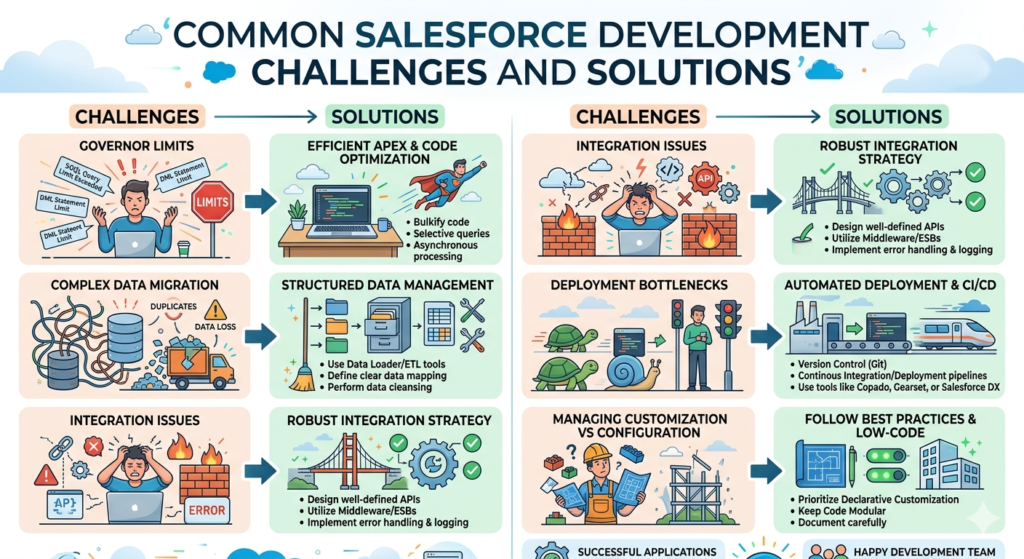
One of the first challenges every Salesforce developer encounters is governor limits. Since Salesforce is a multi-tenant platform, resources are shared among thousands of organizations. To ensure fair usage, Salesforce imposes limits on CPU time, database operations, heap size, API calls, and many other resources.
Developers often run into errors when processing large amounts of data or writing inefficient code. For example, placing SOQL queries or DML statements inside loops can quickly exceed system limits.
The best solution is to follow bulkification principles. Instead of processing records one at a time, developers should handle records in collections. Queries and DML operations should be moved outside loops whenever possible. Using Maps and Sets can also help improve efficiency and reduce resource consumption.
Managing Complex Integrations
Modern businesses rely on multiple applications working together. Salesforce is often connected with ERP systems, accounting software, marketing platforms, payment gateways, and external databases.
Integration projects can become complicated due to different data formats, authentication methods, and system behaviors. API failures, network issues, and data synchronization problems can create additional challenges.
A good approach is to use Salesforce integration tools such as Platform Events, Named Credentials, External Services, and Middleware solutions. Developers should also implement proper error handling, logging mechanisms, and retry strategies to ensure integrations remain reliable.
Data Quality and Duplicate Records
Data is the foundation of every CRM system. However, maintaining clean and accurate data is not always easy. Duplicate records, incomplete information, and inconsistent data entry can affect reporting and business decisions.
For example, if multiple records exist for the same customer, sales teams may struggle to get a complete view of customer interactions.
Developers can address this challenge by implementing validation rules, duplicate management rules, and automation that checks data before records are saved. Regular data audits and cleanup processes also help maintain data quality over time.
Performance Issues in Large Organizations
As organizations grow, the volume of data stored in Salesforce increases significantly. Applications that work well with a few thousand records may start experiencing performance issues when dealing with millions of records.
Slow page loading times, delayed reports, and inefficient queries can impact user productivity.
To improve performance, developers should write selective SOQL queries, avoid unnecessary fields, use indexing where appropriate, and optimize Apex code. Archiving old data and reviewing customizations regularly can also help maintain system performance.
Managing Security Requirements
Security is one of the most important aspects of Salesforce development. Organizations store sensitive customer, financial, and business information within Salesforce, making data protection a top priority.
Developers often face challenges in ensuring users have access to the information they need without exposing sensitive data.
The solution involves understanding Salesforce’s security model, including profiles, permission sets, roles, sharing rules, and field-level security. Developers should always respect security settings in Apex code by using security-enforced queries and proper access controls.
Regular security reviews can help identify potential vulnerabilities before they become serious issues.
Handling Deployment Challenges
Moving changes from a sandbox environment to production can sometimes be stressful. Missing dependencies, test failures, validation errors, and configuration mismatches often cause deployment delays.
Many development teams struggle when multiple developers are working on the same project simultaneously.
Using version control systems such as Git can greatly improve deployment management. Following structured release processes, maintaining proper documentation, and conducting thorough testing before deployment can reduce the chances of unexpected issues.
Tools like Salesforce DevOps Center and CI/CD pipelines can further simplify deployment activities.
Writing Maintainable Code
As projects become larger, maintaining custom code becomes increasingly difficult. Poorly structured code can make debugging, testing, and future enhancements more challenging.
Developers sometimes focus on solving immediate business requirements without considering long-term maintainability.
Following coding standards, creating reusable components, using design patterns, and writing clear documentation can make applications easier to manage. Regular code reviews also help identify areas for improvement and encourage best practices within development teams.
Test Coverage and Unit Testing
Salesforce requires a minimum level of Apex test coverage before code can be deployed to production. While achieving the required percentage may seem simple, writing meaningful test cases is often challenging.
Many developers create tests solely to increase coverage rather than validating actual business logic.
Effective unit tests should cover positive scenarios, negative scenarios, bulk operations, and exception handling. Well-designed test classes improve application reliability and reduce the risk of production issues.
Testing should be treated as an essential part of development rather than a deployment requirement.
Managing Changing Business Requirements
Business needs evolve constantly. New processes, regulations, and customer expectations often require Salesforce applications to be modified after implementation.
Developers may face challenges when existing customizations become difficult to adapt to new requirements.
Building flexible and scalable solutions from the beginning can help address this issue. Using configuration-based approaches such as Flows, Custom Metadata Types, and Dynamic Forms allows organizations to make changes with minimal code modifications.
Future-proofing solutions saves significant time and effort in the long run.
Keeping Up with Salesforce Updates
Salesforce releases new features and enhancements multiple times every year. While these updates provide exciting opportunities, they also require developers to stay informed and adapt existing solutions when necessary.
Ignoring new releases can result in missed opportunities to improve performance, reduce technical debt, or simplify processes.
Developers should regularly review release notes, participate in Trailhead learning modules, and explore new features in sandbox environments before implementing them in production.
Continuous learning is essential for long-term success in the Salesforce ecosystem.
Conclusion
Salesforce development offers endless possibilities for creating powerful business solutions, but it also comes with unique challenges. From governor limits and integrations to security, performance, and deployments, developers must constantly balance functionality, scalability, and maintainability.
The key to overcoming these challenges is understanding the platform deeply, following best practices, and planning solutions with future growth in mind. By writing efficient code, maintaining strong security standards, implementing proper testing, and staying updated with platform innovations, developers can build reliable Salesforce applications that continue to deliver value as business needs evolve.
Every challenge in Salesforce development is an opportunity to improve your skills, refine your approach, and create better solutions for users and organizations alike.