
Introduction
If you’re planning to start your career as a Salesforce Consultant or Business Analyst (BA), one of the first things you’ll come across is a Business Requirements Document (BRD).
Many freshers think Salesforce projects begin with coding or configuration, but that’s not true. Every successful Salesforce project starts with understanding the client’s business needs. This understanding is captured in a document called the Business Requirements Document (BRD).
A BRD acts as a bridge between the client and the implementation team. It ensures that everyone involved in the project understands the business goals, project scope, and expected outcomes before development begins.
In this blog, you’ll learn what a BRD is, who uses it, its main components, best practices, and a simple Salesforce example.
What is a BRD?
A Business Requirements Document (BRD) is a document that captures the business objectives, problems, requirements, and expectations for a project. It focuses on what the business wants to achieve, not how the solution will be built.
The BRD is prepared before development starts so that developers, administrators, consultants, testers, and stakeholders all have a common understanding of the project.
Simple Definition
A BRD is a document that explains:
- What problem the business is facing.
- What solution the business expects.
- What features should be included.
- What the success criteria are.
Why is a BRD Important?
Imagine a client says:
“I want to improve my customer support process.”
This statement is too broad. Different people may interpret it differently.
A Business Analyst discusses the requirement with the client and documents it in a BRD.
The BRD might clarify that the client wants to:
- Customers to create support cases online.
- Cases to be assigned automatically.
- Customers to receive email notifications.
- Managers to track case performance using dashboards.
Now everyone understands exactly what the client expects.
Primary BRD Audience
A BRD is shared with everyone involved in the project.
| Audience | Purpose |
|---|---|
| Business Stakeholders | Define business goals and approve requirements. |
| Business Analyst | Prepares and maintains the BRD. |
| Project Manager | Plans project timelines and resources. |
| Salesforce Consultant | Understands business requirements and suggests solutions. |
| Salesforce Developers | Develop custom functionality based on business needs. |
| Salesforce Administrators | Configure standard Salesforce features. |
| QA/Test Engineers | Create test cases based on documented requirements. |
| Client | Reviews and approves the final document. |
Main Components of a BRD
A well-written BRD contains several important sections.
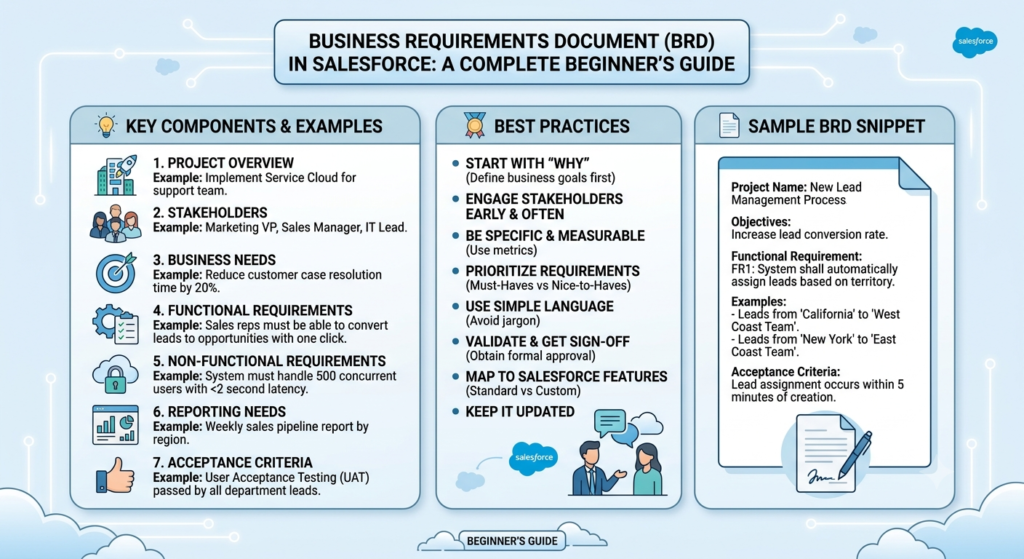
1. Project Overview
Provides a brief introduction to the project.
Example
Project Name:
Customer Service Automation
Purpose:
Improve customer support by automating case management.
2. Business Objectives
This section explains why the project is being implemented.
Example objectives:
- Improve customer satisfaction.
- Reduce manual work.
- Increase productivity.
- Automate business processes.
- Improve reporting.
3. Problem Statement
This explains the current business challenges.
Example:
- Customer complaints are managed manually.
- Cases are assigned through emails.
- No centralized tracking system.
- Managers cannot monitor team performance.
4. Project Scope
Defines what is included and excluded.
In Scope
- Online Case Creation
- Case Assignment
- Email Notifications
- Reports and Dashboards
Out of Scope
- Mobile Application
- AI Chatbot
- WhatsApp Integration
5. Business Requirements
This is the most important section of the BRD.
Example:
- Customers should be able to create cases online.
- Cases should be assigned automatically based on priority.
- Agents should receive notifications.
- Managers should view dashboards.
- Customers should receive status updates.
6. Stakeholders
Lists everyone involved in the project.
Example:
- Client
- Business Analyst
- Salesforce Consultant
- Project Manager
- Developers
- QA Team
7. Assumptions and Constraints
Assumptions
- Salesforce licenses are available.
- Users have internet access.
Constraints
- Project must finish within three months.
- Budget is fixed.
- Existing Salesforce org must be used.
8. Success Criteria
Defines how project success will be measured.
Example:
- Reduce case assignment time by 50%.
- Improve customer satisfaction.
- Reduce manual work.
- Increase agent productivity.
9. Approval Section
The final section includes stakeholder approvals before development begins.
BRD Best Practices
Writing a BRD is not just about documenting requirements—it is about making sure the document is easy to understand and useful for everyone involved.
Some best practices include:
- Understand the client’s business before documenting requirements.
- Ask clear questions during requirement gathering sessions.
- Write requirements in simple and easy-to-understand language.
- Avoid technical terms unless necessary.
- Keep business requirements separate from technical implementation.
- Clearly define the project scope.
- Review the BRD with stakeholders before finalizing it.
- Update the document whenever requirements change.
- Obtain formal approval from stakeholders before development starts.
Example BRD
Project Name
Customer Support Automation
Business Objective
Develop a Salesforce Service Cloud solution to improve customer support and reduce manual effort.
Business Requirements
- Customers can create support cases through a web form.
- Cases should be automatically assigned to available agents.
- Customers should receive email notifications after case creation.
- Managers should monitor case performance through dashboards.
- Agents should update case status from the Service Console.
Stakeholders
- Client
- Business Analyst
- Salesforce Consultant
- Project Manager
- Development Team
- QA Team
Success Criteria
- Reduce manual case assignment.
- Improve customer response time.
- Increase agent productivity.
- Improve customer satisfaction.
Real Salesforce Scenario
Suppose a retail company receives hundreds of customer complaints every day through emails.
Current Process:
- Customers send emails.
- Employees manually create cases.
- Managers assign cases manually.
- Customers don’t receive status updates.
Problems:
- Slow response time.
- Duplicate cases.
- Manual effort.
- No visibility into case status.
After discussing with the client, the Business Analyst prepares a BRD with requirements such as:
- Customers should submit cases online.
- Cases should be assigned automatically using Salesforce Assignment Rules.
- Customers should receive automatic email notifications.
- Managers should access dashboards showing open and closed cases.
Using this BRD, the Salesforce Consultant designs the solution, the Admin configures standard features, and the Developer builds any custom functionality needed.
Conclusion
A Business Requirements Document (BRD) is one of the most important documents in any Salesforce project. It ensures that business goals are clearly documented before development begins, helping all stakeholders stay aligned throughout the project.
Whether you’re a Salesforce Consultant, Business Analyst, Administrator, or Developer, understanding how to read and create a BRD is an essential skill. For freshers, mastering BRDs will not only improve your project knowledge but also help you communicate effectively with clients and contribute to successful Salesforce implementations.