
Artificial Intelligence is changing the way businesses work, and Salesforce is leading this transformation with powerful AI solutions. Over the years, Salesforce has introduced several AI-driven tools to help organizations improve productivity, automate tasks, and deliver better customer experiences. Two names that are creating a lot of buzz in the Salesforce ecosystem today are Einstein AI and Agentforce.
Many Salesforce users often get confused between these two technologies. Since both are related to AI and automation, it’s easy to assume they do the same thing. However, Einstein AI and Agentforce serve different purposes and are designed to solve different business challenges.
If you’re exploring Salesforce AI capabilities or planning your organization’s AI strategy, understanding the difference between Einstein AI and Agentforce is important. Let’s break it down in simple terms.
Understanding Einstein AI
Einstein AI has been part of Salesforce for several years. It was introduced to bring artificial intelligence directly into the Salesforce platform. The primary goal of Einstein AI is to help users make smarter decisions by analyzing data and providing predictions, recommendations, and automation.
Think of Einstein AI as an intelligent assistant working behind the scenes. It looks at your business data, identifies patterns, and helps users make informed decisions without spending hours analyzing reports.
For example, Einstein can predict which leads are most likely to convert into customers. It can suggest the best next action for a sales representative, recommend products to customers, or even analyze customer sentiment from emails and conversations.
The strength of Einstein AI lies in its ability to provide insights based on data. It helps organizations become more proactive rather than reactive.
What is Agentforce?
Agentforce is Salesforce’s next-generation AI platform designed to create autonomous AI agents that can perform tasks, make decisions, and interact with customers or employees with minimal human intervention.
Instead of simply providing recommendations like Einstein AI, Agentforce can actually take action.
Imagine a customer asks a support question through a company website. Instead of routing the request to a human agent immediately, an Agentforce-powered AI agent can understand the question, search for relevant information, provide an answer, update Salesforce records, and even complete follow-up actions automatically.
This makes Agentforce much more than a prediction tool. It acts like a digital employee that can handle business processes independently while still following company rules and guidelines.
The Core Difference
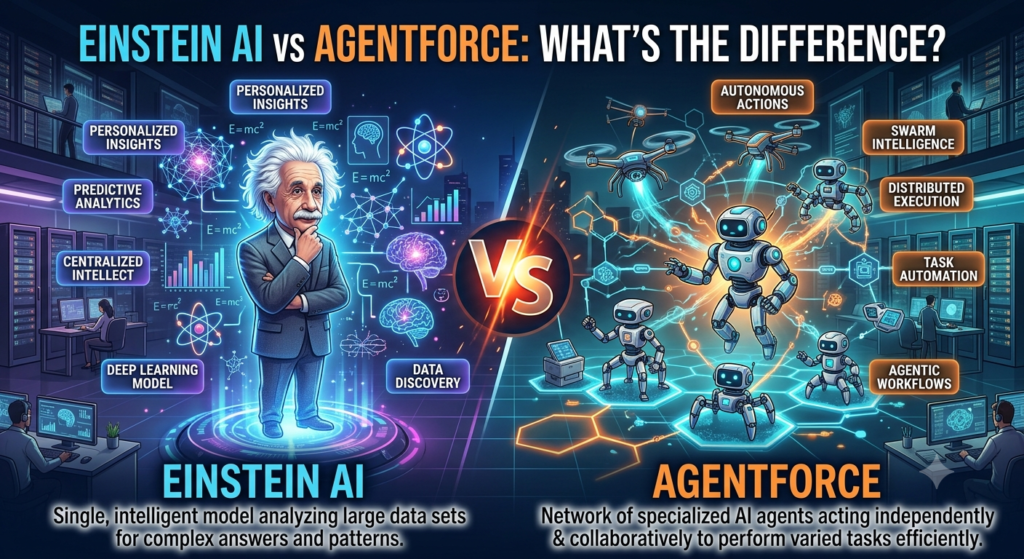
The easiest way to understand the difference is this:
Einstein AI helps people make better decisions.
Agentforce helps AI agents perform tasks and complete work.
Einstein focuses on predictions, recommendations, analytics, and intelligent insights. Agentforce focuses on action, automation, execution, and autonomous workflows.
One technology supports human users, while the other enables AI-driven agents to work alongside humans.
How Einstein AI Works
Einstein AI uses machine learning and data analysis to identify trends and patterns within Salesforce data. It continuously learns from business activities and improves its recommendations over time.
Sales teams use Einstein Lead Scoring to identify promising prospects. Service teams use Einstein Case Classification to automatically categorize customer cases. Marketing teams use Einstein Engagement Scoring to determine which customers are most likely to interact with campaigns.
In all these situations, Einstein provides valuable insights, but the final action is usually performed by a human user.
This approach helps employees work faster and make more informed decisions without replacing their involvement in the process.
How Agentforce Works
Agentforce takes AI capabilities a step further by introducing autonomous agents.
These agents are capable of understanding requests, accessing business data, following company rules, and completing specific tasks on behalf of users.
For example, an Agentforce service agent can answer customer inquiries, create support tickets, update records, schedule appointments, and provide personalized responses without requiring constant supervision.
Similarly, a sales agent can qualify leads, follow up with prospects, update opportunities, and assist sales representatives throughout the sales cycle.
Because Agentforce is connected to Salesforce data and workflows, it can operate within the same business environment that employees use every day.
Real-World Example
Imagine a customer submits a question about their order status.
With Einstein AI, the system may analyze customer history and suggest the best response for a support representative. The human agent reviews the recommendation and sends the reply.
With Agentforce, the AI agent can receive the request, retrieve order details, generate a response, update the case record, and communicate directly with the customer without requiring a human agent to intervene.
This example clearly shows the difference between assistance and autonomous action.
Benefits of Einstein AI
Organizations that use Einstein AI benefit from better decision-making, improved forecasting, and increased productivity.
Sales teams can prioritize opportunities more effectively. Marketing teams can create more targeted campaigns. Service teams can resolve customer issues faster with intelligent recommendations.
Since Einstein is deeply integrated into Salesforce, businesses can leverage AI without making major changes to existing processes.
It works as an intelligent advisor that helps employees perform their jobs more efficiently.
Benefits of Agentforce
Agentforce offers a different set of advantages.
Businesses can automate repetitive tasks, reduce operational costs, improve response times, and provide support around the clock.
AI agents can handle thousands of interactions simultaneously, helping organizations scale customer service and business operations without significantly increasing workforce requirements.
This allows human employees to focus on more strategic, creative, and complex tasks while AI agents manage routine activities.
Which One Should You Choose?
The answer depends on your business goals.
If your organization wants better insights, predictions, recommendations, and data-driven decision-making, Einstein AI is the right choice.
If your goal is to automate workflows, deploy AI-powered assistants, and create autonomous agents capable of performing business tasks, Agentforce is the better solution.
In reality, many organizations will benefit from using both technologies together.
Einstein AI can provide intelligence and predictions, while Agentforce can use that intelligence to perform actions automatically. Together, they create a powerful combination that helps businesses become more efficient and customer-focused.
Final Thoughts
Salesforce’s AI journey has evolved significantly over the years. Einstein AI introduced intelligent insights and predictive capabilities that helped businesses make smarter decisions. Agentforce represents the next stage of that evolution by enabling autonomous AI agents that can actively perform work.
The key difference is simple: Einstein AI tells you what should happen, while Agentforce helps make it happen.
As businesses continue adopting AI-driven solutions, understanding how these technologies complement each other will help organizations unlock greater productivity, improve customer experiences, and stay ahead in an increasingly competitive digital landscape.