
Implementing Salesforce Service Cloud is not just about setting up a support system. It’s about creating a smooth, fast, and reliable customer service experience.
Many companies invest in Service Cloud but still struggle with slow response times, poor case management, and unhappy customers. The reason is simple — they miss the key factors required for a successful implementation.
In this blog, you will learn everything step by step in simple English — from planning to execution — so you can build a Service Cloud system that actually works and delivers real business value.
What is Salesforce Service Cloud?
Salesforce Service Cloud is a customer service platform that helps businesses manage:
- Customer support cases
- Omnichannel communication (email, chat, phone, social)
- Knowledge base
- Service automation
It allows support teams to provide faster and better service with a complete customer view.
Why Getting Implementation Right is Important
If Service Cloud is implemented poorly:
- Agents take longer to resolve cases
- Customers get frustrated
- Data becomes messy
- Support cost increases
But when done right:
- Response time improves
- Customer satisfaction increases
- Agents become more productive
- Support operations become scalable
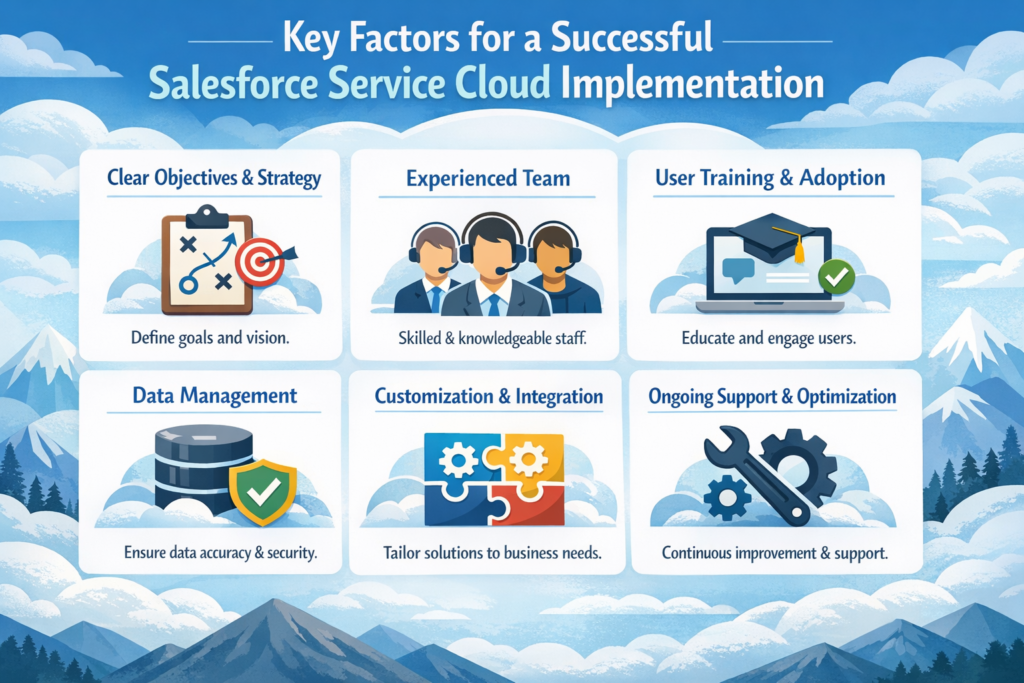
Key Factors for a Successful Salesforce Service Cloud Implementation
Let’s break this down step by step in a practical way.
1. Define Clear Customer Service Goals
Before implementation, understand what you want to achieve.
Ask yourself:
- Do you want faster response time?
- Do you want better case tracking?
- Do you want to reduce support workload?
Example goals:
- Reduce case resolution time by 30%
- Improve customer satisfaction score
- Automate repetitive tasks
Why this matters:
Without clear goals, your implementation will lack direction.
2. Understand Your Support Process
Map your current customer support journey.
Identify:
- How cases are created
- How they are assigned
- How they are resolved
- Where delays happen
Example:
A customer raises a complaint → case is created → assigned to agent → resolved → closed
Tip:
Fix process gaps before implementing Service Cloud.
3. Design an Efficient Case Management System
Case management is the core of Service Cloud.
Best practices:
- Define clear case lifecycle stages
- Use proper case statuses (New, In Progress, Escalated, Closed)
- Set priority levels
Example:
High-priority cases should be resolved faster than low-priority ones.
4. Implement Omnichannel Support
Customers use multiple channels today.
Channels to integrate:
- Chat
- Phone
- Social media
Why it matters:
Customers expect seamless support regardless of channel.
Example:
A customer starts a chat and continues via email — agent should see full history.
5. Use Automation to Improve Efficiency
Automation reduces manual work and speeds up service.
Automate:
- Case assignment (Assignment Rules)
- Auto responses
- Escalations
- Follow-ups
Tools to use:
- Flow
- Macros
- Einstein Bots
Tip:
Start with simple automation, then scale.
6. Build a Strong Knowledge Base
A knowledge base helps both agents and customers.
Benefits:
- Faster issue resolution
- Reduced repetitive questions
- Self-service for customers
Example:
Instead of answering the same query daily, agents can share a knowledge article.
7. Focus on Agent Experience
Happy agents provide better service.
Best practices:
- Clean and simple UI
- Quick access to information
- Use console view for efficiency
Example:
Agents should not search multiple pages to resolve a case.
8. Maintain High Data Quality
Accurate data is critical for service success.
Ensure:
- Mandatory fields for case creation
- Standard picklist values
- Duplicate management
Example:
Incorrect case data leads to wrong reporting and delays.
9. Implement Proper Security and Access Control
Protect sensitive customer data.
Use:
- Roles
- Profiles
- Permission Sets
Best practice:
Give access only to required data.
10. Use Reports and Dashboards for Insights
Track performance using reports.
Important metrics:
- Case resolution time
- First response time
- Customer satisfaction
- Agent performance
Tip:
Dashboards should be simple and easy to understand.
11. Plan Data Migration Carefully
If you are moving from another system:
Steps:
- Clean existing data
- Map fields correctly
- Test migration
- Validate results
Common mistake:
Migrating poor-quality data into Salesforce
12. Provide Proper Training to Agents
Training is critical for adoption.
Include:
- How to use Service Cloud
- Case handling process
- Real-life scenarios
Tip:
Keep training practical, not theoretical.
13. Test Before Go-Live
Testing ensures everything works smoothly.
Types:
- Functional testing
- User Acceptance Testing (UAT)
- Integration testing
Goal:
Avoid surprises after launch.
14. Plan a Smooth Go-Live
A well-planned go-live ensures success.
Steps:
- Inform users in advance
- Provide support during launch
- Monitor system closely
15. Continuous Improvement After Go-Live
Implementation is not the end.
After launch:
- Collect feedback
- Track system usage
- Improve processes
Tip:
Keep evolving with business needs.
Common Mistakes to Avoid
1. Overcomplicating the System
Keep it simple for better adoption.
2. Ignoring User Experience
If agents struggle, productivity drops.
3. Poor Data Management
Bad data leads to poor service.
4. Lack of Automation
Manual processes slow down support.
Pro Tips for Better Implementation
- Start with core features first
- Focus on customer experience
- Use automation wisely
- Train users properly
- Monitor performance regularly
Conclusion
Implementing Salesforce Service Cloud successfully requires more than just technical setup. It requires the right strategy, planning, and execution.
When done correctly, Service Cloud helps you:
- Deliver faster support
- Improve customer satisfaction
- Reduce operational cost
- Scale your service operations
Final Thought
Customer service is one of the most important parts of any business.
If your Service Cloud implementation is strong, your customer experience becomes strong.
And when customer experience improves, business growth follows automatically.