
Introduction
Have you ever wondered how Salesforce projects are completed on time while handling hundreds of requirements, bugs, and feature requests?
The answer is Agile Scrum.
Almost every modern Salesforce company follows Agile Scrum because it helps teams deliver features faster, improve quality, and quickly respond to changing business requirements.
If you’re a beginner preparing for a Salesforce Developer or Administrator role, understanding Agile Scrum is just as important as learning Apex or Lightning Web Components (LWC). During interviews, employers often ask questions about Agile because they want developers who can work effectively in real project environments.
In this blog, we’ll understand Agile Scrum in simple English using a real-world Salesforce project example.
What is Agile?
Agile is a project management methodology where work is divided into small parts instead of building the entire project at once.
Instead of spending one year developing everything, the team delivers small features every 2–3 weeks.
This allows customers to:
- See progress quickly
- Give feedback
- Request changes
- Reduce project risk
Traditional Waterfall Approach
Imagine building a house.
You first complete:
- Foundation
- Walls
- Roof
- Painting
- Interior
Only after everything is complete does the customer see the final house.
If the customer wants changes, it becomes expensive and time-consuming.
Agile Approach
Now imagine building one room at a time.
First:
- Bedroom
Customer reviews it.
Next:
- Kitchen
Customer reviews again.
Then:
- Living Room
This allows improvements after every stage.
Salesforce projects work in the same way.
What is Scrum?
Scrum is a framework used to implement Agile.
It provides a structured process that helps teams:
- Plan work
- Build features
- Test
- Deploy
- Improve continuously
Scrum keeps everyone organized.
Scrum Team Roles
A Salesforce Scrum team usually consists of the following members.
Product Owner (PO)
The Product Owner represents the business.
Their responsibilities include:
- Gathering requirements
- Prioritizing features
- Writing User Stories
- Accepting completed work
Think of the Product Owner as the customer’s representative.
Scrum Master
The Scrum Master ensures Agile rules are followed.
Responsibilities:
- Conduct Daily Stand-up meetings
- Remove blockers
- Help the team
- Organize Sprint meetings
- Improve team productivity
The Scrum Master does not write code.
Instead, they help developers work smoothly.
Salesforce Developers
Developers are responsible for:
- Writing Apex
- Developing LWC
- Creating Flows
- Writing Triggers
- Integrating APIs
- Fixing Bugs
Salesforce Administrator
The Administrator usually works on:
- Objects
- Fields
- Validation Rules
- Flow Builder
- Reports
- Dashboards
- Security
QA/Test Engineer
Responsibilities include:
- Testing features
- Logging defects
- Regression testing
- UAT support
What is a Sprint?
A Sprint is a fixed period during which the team completes a set of work.
Most Salesforce companies use:
- 2 Weeks
- 3 Weeks
Example
Sprint Duration:
1st July – 14th July
The team plans work on Day 1.
Development happens during the Sprint.
Testing is completed before the Sprint ends.
Finally, the feature is demonstrated to the customer.
Salesforce Project Example
Suppose a company wants to automate Loan Processing.
Business Requirements:
- Customer submits loan application.
- Manager approves loan.
- Customer receives an email.
- Loan status updates automatically.
- Dashboard shows loan statistics.
Instead of building everything together, Agile divides it into multiple Sprints.
Sprint 1
Goal:
Customer submits Loan Application.
Tasks:
- Create Loan Object
- Create Fields
- Build Screen Flow
- Create Validation Rules
Sprint 2
Goal:
Loan Approval
Tasks:
- Approval Process
- Apex Trigger
- Email Notification
Sprint 3
Goal:
Reports and Dashboards
Tasks:
- Reports
- Dashboards
- Permission Sets
Each Sprint delivers working software.
Product Backlog
The Product Backlog is a list of everything the customer wants.
Example
| Priority | User Story |
|---|---|
| High | Customer should create Loan Application |
| High | Manager should approve Loan |
| Medium | Customer receives Email |
| Medium | Reports |
| Low | Mobile Enhancement |
The Product Owner manages this list.
User Story
A User Story describes a requirement from the user’s perspective.
Format:
As a
Customer
I want to
Submit a loan application
So that
I can apply online.
Simple.
Clear.
Easy to understand.
Sprint Planning
Sprint Planning is the first meeting of every Sprint.
The team decides:
- Which User Stories to take
- Estimated effort
- Priority
- Dependencies
Example
Sprint Capacity
Developer A = 30 Hours
Developer B = 40 Hours
Developer C = 50 Hours
Total Capacity
120 Hours
The team selects work that fits within those 120 hours.
Story Points
Instead of estimating hours, Agile uses Story Points.
Example
| Story | Story Points |
|---|---|
| Create Object | 2 |
| Validation Rules | 3 |
| Flow | 5 |
| Apex Trigger | 8 |
| REST Integration | 13 |
Higher Story Points mean more complexity.
Daily Stand-up
Every morning, the team has a 15-minute meeting.
Everyone answers three questions:
- What did I complete yesterday?
- What will I work on today?
- Is there any blocker?
Example
Developer:
Yesterday:
Completed Loan Flow.
Today:
Working on Approval Process.
Blocker:
Need API details from Integration Team.
Simple.
No lengthy discussions.
Development Phase
Now developers start coding.
Typical Salesforce tasks include:
- Apex Classes
- Apex Triggers
- Lightning Web Components
- Flow Builder
- SOQL
- REST APIs
- Validation Rules
Developers also write Test Classes.
Code Review
Before deployment, senior developers review code.
They check:
- Naming conventions
- Governor Limits
- Bulkification
- Security
- Performance
- Best Practices
This improves code quality.
Testing Phase
QA tests the feature.
Testing includes:
- Functional Testing
- Integration Testing
- Regression Testing
- Negative Testing
If bugs are found, developers fix them.
User Acceptance Testing (UAT)
After QA testing, business users test the application.
Example
Loan Officer logs in.
Creates Loan.
Approves Loan.
Receives Email.
If everything works correctly, the feature is approved.
If not, change requests are created.
Sprint Review
At the end of the Sprint, the team demonstrates completed work.
Business users provide feedback.
Example
Customer says:
“We also need SMS notification.”
This becomes a User Story for the next Sprint.
Sprint Retrospective
The team discusses:
What went well?
Examples:
- Good teamwork
- No production bugs
- Completed Sprint on time
What can improve?
Examples:
- Better estimation
- Faster code reviews
- More automated testing
The goal is continuous improvement.
Deployment
After approval, changes are deployed.
Typical deployment tools include:
- Change Sets
- Salesforce DX (SFDX)
- Copado
- Gearset
- Jenkins
Deployment path:
Developer Sandbox → QA Sandbox → UAT Sandbox → Production
Production Support
The project doesn’t end after deployment.
The support team handles:
- User issues
- Bug fixes
- Performance improvements
- Enhancements
- Monitoring integrations
Example
A customer reports:
Loan Approval Email is not received.
Support team:
- Checks Debug Logs
- Verifies Flow
- Reviews Apex Logs
- Fixes Email Configuration
Issue resolved.
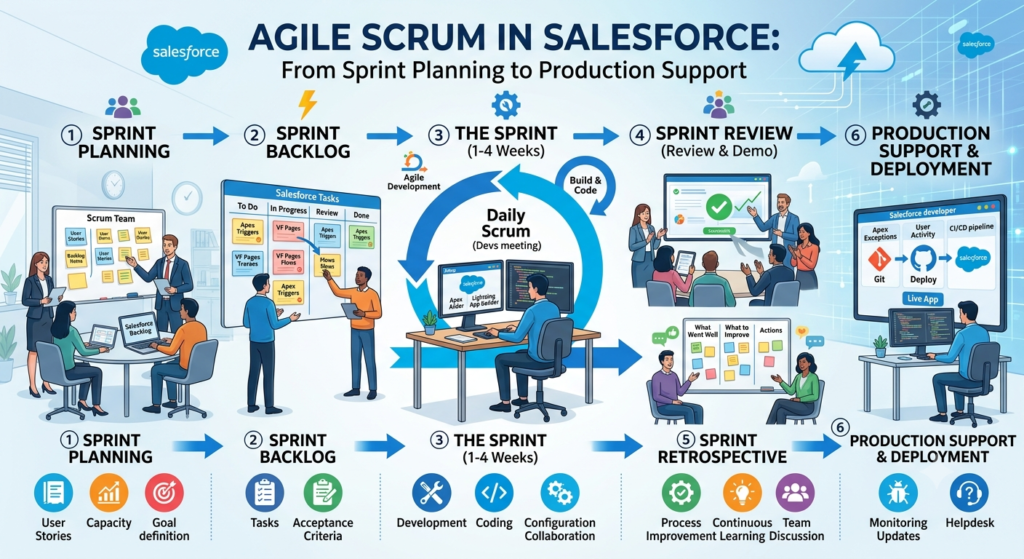
Complete Salesforce Agile Workflow
Business Requirement
↓
Product Backlog
↓
Sprint Planning
↓
Development
↓
Code Review
↓
Testing
↓
User Acceptance Testing (UAT)
↓
Sprint Review
↓
Deployment
↓
Production Support
Why Salesforce Companies Use Agile Scrum
Agile Scrum provides several benefits:
- Faster delivery of features
- Better collaboration among teams
- Continuous customer feedback
- High-quality code through reviews
- Easier testing and deployments
- Better project visibility
- Faster issue resolution
- Reduced project risk
- Improved customer satisfaction
Interview Questions
1. What is Agile?
Agile is a software development methodology where work is divided into small iterations called Sprints, allowing teams to deliver features quickly and continuously improve based on customer feedback.
2. What is Scrum?
Scrum is an Agile framework that helps teams organize work through defined roles, events, and artifacts to deliver software efficiently.
3. What is a Sprint?
A Sprint is a fixed time period, usually 2–3 weeks, during which a team completes a set of planned user stories.
4. What happens during Sprint Planning?
The team selects user stories from the product backlog, estimates the effort, and commits to completing them within the Sprint.
5. What is UAT?
User Acceptance Testing (UAT) is the final testing phase where business users verify that the implemented features meet their requirements before deployment.
6. What is Production Support?
Production Support involves monitoring live Salesforce applications, resolving user issues, fixing bugs, improving performance, and supporting business operations after deployment.
Final Thoughts
Learning Agile Scrum is essential for every Salesforce professional because it reflects how real-world projects are managed. Whether you’re a Salesforce Administrator, Developer, Business Analyst, or QA Engineer, understanding Sprint Planning, User Stories, Daily Stand-ups, Testing, UAT, Deployment, and Production Support will help you collaborate effectively with your team and deliver successful Salesforce solutions.
Master the Salesforce platform—but also master the Agile process that brings those solutions to life.