
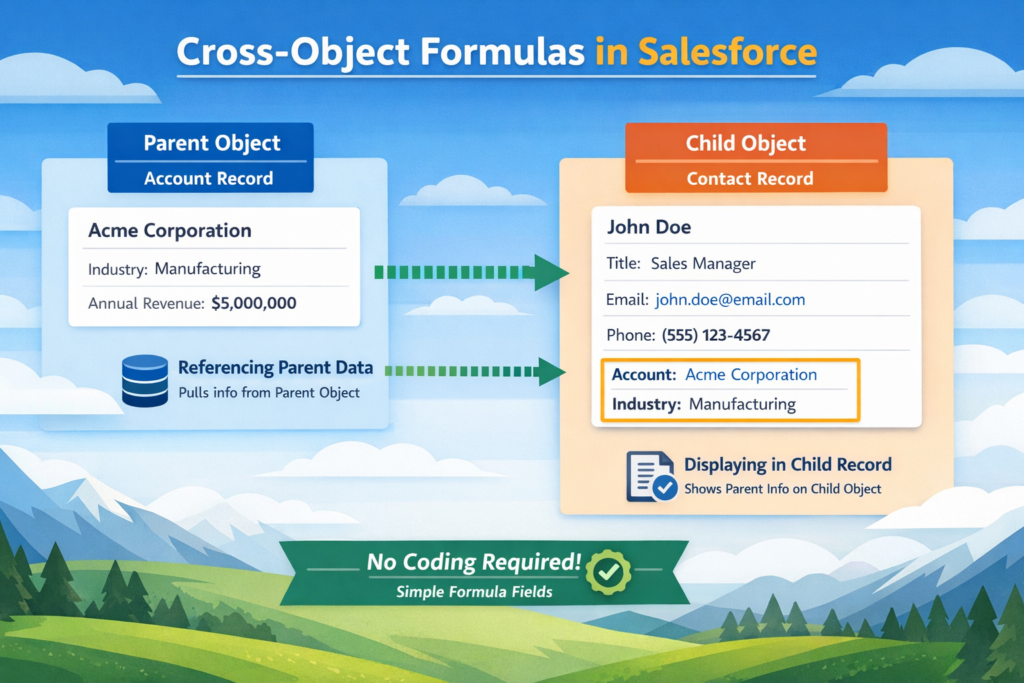
Salesforce stores data in a structured way using objects and relationships. In real business scenarios, data from one object is often needed on another related object. Instead of copying data or writing code, Salesforce provides a simple and powerful feature called Cross-Object Formulas.
This blog explains what cross-object formulas are, how they work, practical examples, real-world use cases, limitations, and best practices in simple terms.
What Is a Cross-Object Formula?
A cross-object formula is a formula field that allows you to reference and use data from a related parent object.
In simple words, it lets you display or calculate values from a parent record directly on a child record without using Apex, triggers, or automation.
How Cross-Object Formulas Work
Cross-object formulas work through object relationships, such as:
-
Lookup relationships
-
Master-Detail relationships
A formula field on a child object can access fields from its parent object using relationship paths.
Important rule:
-
You can only reference parent object fields
-
You cannot reference child records or unrelated objects
Scenario
You have:
-
Account (Parent)
-
Contact (Child)
Requirement:
Show the Account Industry on the Contact record.
Formula Used on Contact Object
Result:
The Industry value from the Account automatically appears on the Contact record. If the Account Industry changes, the Contact record reflects the updated value instantly.
Example 1: Discount Calculation Based on Account Type
Use Case:
A business gives a discount on opportunities only if the Account Type is “Customer”.
Object: Opportunity
Formula Field:
Outcome:
The discount value is calculated automatically based on the Account Type without writing any code.
Example 2: Display Account Owner on Opportunity
Use Case:
Sales teams want to see who owns the Account directly on the Opportunity record.
Formula Field:
Outcome:
The Opportunity record always shows the current Account Owner name.
Example 3: Approval Rule Using Parent Data
Use Case:
An approval process should trigger if the Account Rating is “Hot”.
Formula Condition:
Outcome:
Approval logic is driven by Account data without duplicating fields.
Multi-Level Cross-Object Formula Example
Salesforce allows referencing up to 10 levels of parent relationships.
Example:
This pulls the Manager name of the Account Owner onto the Opportunity record.
Note: Deep relationships should be used carefully to avoid performance issues.
Common Use Cases of Cross-Object Formulas
-
Showing parent object information on child records
-
Driving business logic without Apex or triggers
-
Simplifying validation rules and approval processes
-
Reducing data duplication
-
Making reports easier to build and maintain
Cross-Object Formula vs Roll-Up Summary
| Feature | Cross-Object Formula | Roll-Up Summary |
|---|---|---|
| Data Direction | Parent to Child | Child to Parent |
| Aggregation | Not Supported | Supported |
| Code Required | No | No |
| Relationship Type | Lookup or Master-Detail | Master-Detail only |
Limitations of Cross-Object Formulas
-
Cannot reference child records
-
Cannot perform aggregation (SUM, COUNT, MAX)
-
Cannot update parent data
-
Excessive relationship depth can impact performance
-
Not suitable for very large data volumes if overused
Best Practices
-
Use cross-object formulas only when real-time data is required
-
Keep relationship depth as shallow as possible
-
Avoid complex formulas on high-volume objects
-
Use clear and readable formula logic
-
Test performance in large data environments
When Should You Use Cross-Object Formulas?
Use them when:
-
You need real-time parent data on child records
-
You want a no-code or low-code solution
-
Data consistency is critical
Avoid them when:
-
Aggregation is required
-
Data needs to flow from child to parent
-
Performance at scale is a concern
Final Thoughts
Cross-object formulas are a simple yet powerful Salesforce feature that helps build clean, scalable, and maintainable solutions. When used correctly, they reduce code, eliminate redundancy, and improve data accuracy.
For Salesforce Admins and Developers, understanding cross-object formulas is essential for creating efficient business logic without overengineering solutions.