
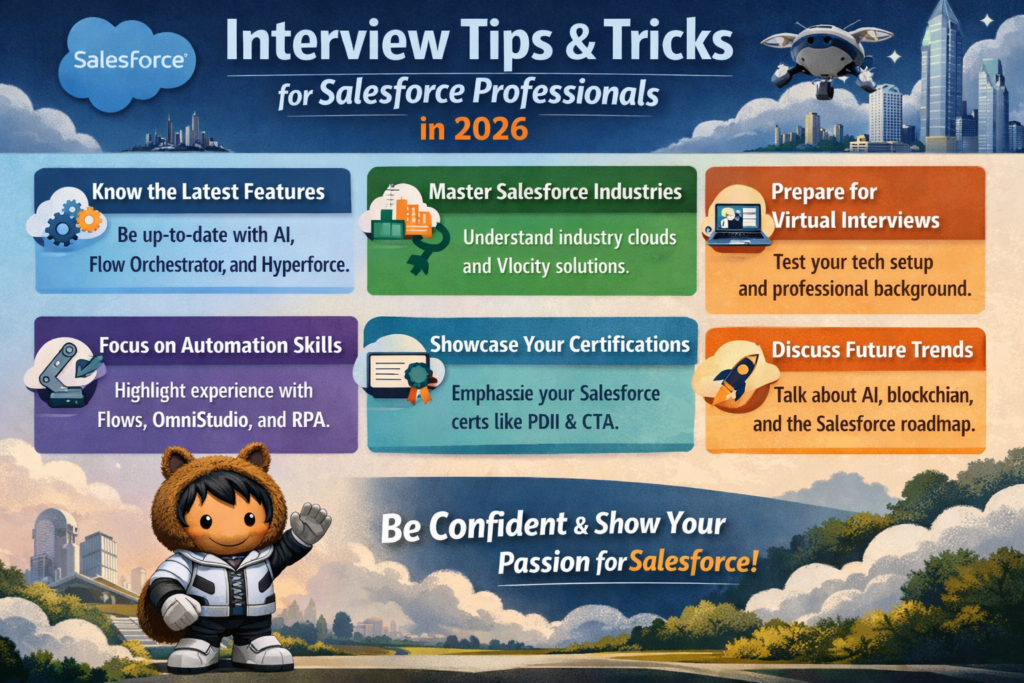
Salesforce interviews in 2026 are not just about knowing features or clearing certifications. Hiring managers today look for real-world thinking, problem-solving skills, and practical experience.
Whether you are a Salesforce Admin, Developer, Consultant, or Architect, interview expectations have evolved. This guide will help you understand what interviewers actually want, how to prepare smartly, and how to stand out from the crowd.
1. Understand What Salesforce Roles Look Like in 2026
Before preparing, it’s important to know how Salesforce roles have changed.
In 2026, companies expect Salesforce professionals to:
-
Work across multiple clouds
-
Understand automation, AI features, and integrations
-
Think like a solution designer, not just a config or code resource
Interviewers will test:
-
How you approach problems
-
How you design scalable solutions
-
How well you understand Salesforce limits and best practices
2. Don’t Just Learn Features, Learn Use Cases
One common mistake candidates make is memorizing features.
Instead of saying:
“I know Flows, Apex, and LWC”
Be ready to explain:
-
Where you used them
-
Why you chose them
-
What problem they solved
Example Interview Question:
Why did you use Flow instead of Apex in your project?
Good answer:
“I used Flow because the logic was simple, needed to be maintained by admins, and did not require complex processing. It also reduced deployment effort and future maintenance.”
This shows decision-making, not just knowledge.
3. Be Clear on Core Salesforce Concepts
No matter how senior you are, interviewers still test basics.
Make sure you are strong in:
-
Object relationships (Lookup vs Master-Detail)
-
Sharing and security model
-
Governor limits
-
Data model design
-
Deployment and change management
In 2026, weak fundamentals are a red flag, especially for senior roles.
4. Real-World Scenario Questions Matter More
Modern Salesforce interviews focus heavily on scenario-based questions.
Example:
“How would you handle large data volumes in Salesforce?”
What interviewers want:
-
Awareness of limits
-
Use of tools like Big Objects, indexing, async processing
-
Performance-focused thinking
Even if your answer is not perfect, structured thinking matters more than exact words.
5. For Developers: Code Logic > Syntax
Interviewers are less interested in perfect syntax and more focused on:
-
Trigger frameworks
-
Bulkification
-
Error handling
-
Reusability
-
Performance optimization
Tip:
Always explain your approach first, then talk about code.
Example:
“I would use a trigger handler framework to keep logic separate, handle bulk records, and make the code easier to test and maintain.”
6. Flows Are No Longer Optional
In 2026, Salesforce expects professionals to be comfortable with Flows.
You should know:
-
When to use Flow vs Apex
-
Screen Flow use cases
-
Record-triggered Flows
-
Orchestration basics
If you ignore Flows, you may look outdated in interviews.
7. Communication Skills Are Tested Silently
Many candidates fail interviews not because of technical gaps, but because of poor explanation skills.
Interviewers observe:
-
How clearly you explain solutions
-
Whether you listen before answering
-
How you handle follow-up questions
Tip:
Pause, understand the question, then answer. Clear thinking beats rushed answers.
8. Be Honest About What You Don’t Know
In 2026, interviewers value honesty over fake confidence.
If you don’t know something:
-
Admit it calmly
-
Explain how you would learn or approach it
Example:
“I haven’t worked directly on this, but based on my experience, I would explore this approach and validate it using Salesforce documentation.”
This shows maturity and learning mindset.
9. Prepare Your Project Stories
Most interviews include questions like:
-
“Tell me about a challenging project”
-
“Describe a production issue you solved”
-
“How did you handle a requirement change?”
Prepare 3–4 strong stories covering:
-
Technical challenge
-
Your role
-
Your decision
-
Final outcome
Real stories build trust.
10. Questions You Should Ask the Interviewer
At the end, always ask thoughtful questions.
Good examples:
-
How does your team manage Salesforce releases?
-
What kind of challenges does the Salesforce team face today?
-
How do you balance automation and customization?
This shows genuine interest and senior mindset.
11. Resume and LinkedIn Matter More Than Ever
In 2026:
-
Interviewers check LinkedIn before calls
-
They scan resumes for impact, not just skills
Your resume should highlight:
-
What you built
-
What problem you solved
-
What result you delivered
Avoid listing tools without context.
Final Thoughts
Salesforce interviews in 2026 are about thinking like a consultant, not just a resource.
If you focus on:
-
Real use cases
-
Clear explanations
-
Strong fundamentals
-
Honest communication
You will stand out naturally.