
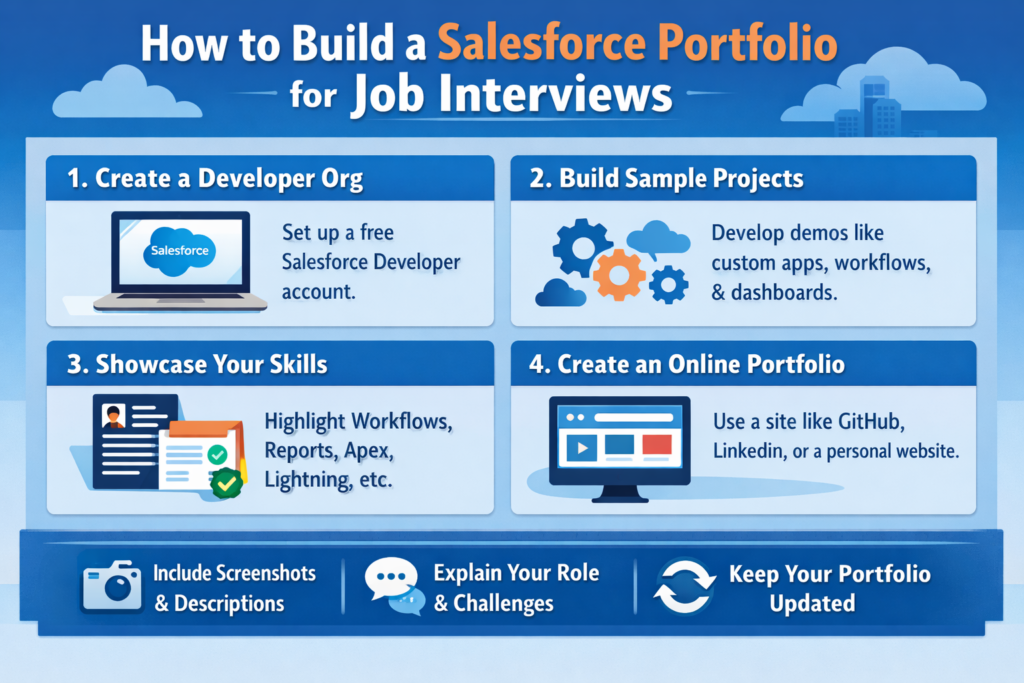
How to Build a Salesforce Portfolio for Job Interviews
Having Salesforce skills is important, but showing those skills clearly is what helps you get interview calls. Many candidates struggle not because they lack knowledge, but because they don’t know how to present their work.
A Salesforce portfolio helps interviewers see what you can actually do, not just what you claim on your resume.
This blog explains step by step how to build a strong Salesforce portfolio that increases your chances of getting hired.
Why a Salesforce Portfolio Matters
Recruiters interview many candidates with similar certifications. A portfolio helps you stand out.
A good portfolio:
-
Proves your hands-on experience
-
Shows your problem-solving skills
-
Builds confidence during interviews
-
Makes technical discussions easier
Even freshers and career switchers can create a strong portfolio.
Step 1: Decide Your Salesforce Role
Before building a portfolio, be clear about the role you are targeting.
Examples:
-
Salesforce Admin
-
Salesforce Developer
-
Salesforce Consultant
-
Salesforce Business Analyst
Your portfolio should match one main role, not everything.
Step 2: Create a Salesforce Developer Org
Sign up for a free Salesforce Developer Edition org.
This org will be used to:
-
Build projects
-
Create objects, flows, and Apex
-
Show real working examples
Keep this org clean and organized.
Step 3: Build Real-World Projects
Do not build random features. Build projects that solve real business problems.
Example Project Ideas
-
Lead Management System with validation rules and flows
-
Case Management with auto-assignment and escalation
-
Opportunity Tracking with reports and dashboards
-
User Access Control using profiles and permission sets
-
Approval process for discounts
Each project should have a clear purpose.
Step 4: Use Key Salesforce Features
Make sure your portfolio shows practical usage of Salesforce features.
For Admin roles:
-
Custom objects and fields
-
Validation rules
-
Flow Builder
-
Reports and dashboards
-
Security model
For Developer roles:
-
Apex classes and triggers
-
SOQL and SOSL
-
Test classes
-
Platform events or integrations
-
Lightning Web Components
Step 5: Document Your Work Properly
This step is often missed but very important.
For every project, write:
-
Problem statement
-
Business requirement
-
Solution approach
-
Salesforce features used
-
Final outcome
Keep the explanation simple and clear.
Step 6: Use GitHub to Show Code (For Developers)
If you are a Salesforce Developer:
-
Create a GitHub account
-
Push Apex classes, triggers, and LWCs
-
Write a clear README file
This shows:
-
Code quality
-
Naming standards
-
Best practices
Recruiters value this a lot.
Step 7: Create Screenshots and Short Videos
Not all interviewers can access your org.
Add:
-
Screenshots of flows, objects, dashboards
-
Short demo videos explaining functionality
This makes your portfolio easy to understand.
Step 8: Build a Simple Portfolio Page
You don’t need a complex website.
You can use:
-
GitHub Pages
-
Notion
-
Google Docs
-
A simple personal website
Include:
-
Introduction
-
Skills summary
-
Project details
-
Screenshots or links
-
Contact information
Step 9: Align Portfolio with Your Resume
Your resume and portfolio must match.
If your resume mentions:
-
Flow automation
-
Apex development
-
Security setup
Your portfolio must show proof of that work.
Step 10: Practice Explaining Your Projects
In interviews, you should be able to explain:
-
Why you built the solution
-
Challenges you faced
-
How you solved them
-
What you would improve next time
This shows real understanding, not memorization.
Common Mistakes to Avoid
-
Too many small, unrelated projects
-
No explanation of business use case
-
Copying projects without understanding
-
Poor naming conventions
-
No test coverage for Apex
Final Thoughts
A Salesforce portfolio is not about perfection.
It is about showing effort, learning, and real skills.
If you can:
-
Build meaningful projects
-
Explain your choices clearly
-
Show working solutions
You already stand out from most candidates.
Start small, improve step by step, and keep updating your portfolio.