
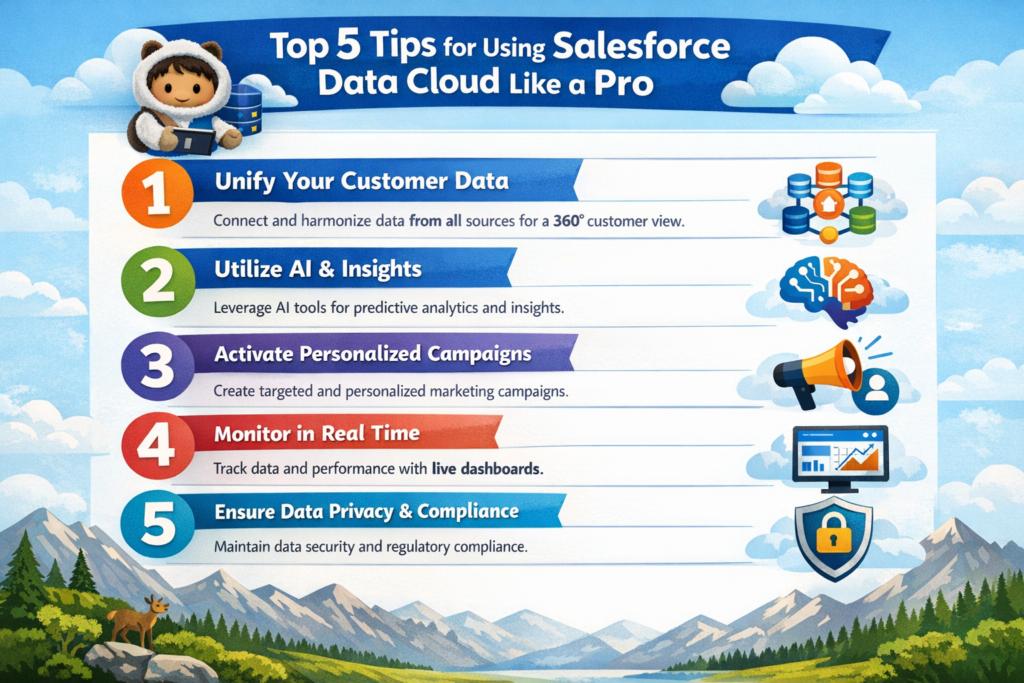
In today’s data-driven world, businesses collect information from many different sources such as websites, mobile apps, marketing platforms, CRM systems, and customer service channels. Managing all this data in one place and turning it into meaningful insights can be challenging. This is where Salesforce Data Cloud plays a powerful role.
Salesforce Data Cloud helps organizations unify their customer data, create a complete customer profile, and deliver personalized experiences across sales, marketing, and service teams. However, simply implementing the platform is not enough. To truly benefit from it, you need to understand how to use it effectively.
In this blog, we will explore five practical tips that can help you use Salesforce Data Cloud like a professional and unlock its full potential.
Understanding Salesforce Data Cloud
Before diving into the tips, it is important to understand what Salesforce Data Cloud actually does.
Salesforce Data Cloud is a data platform designed to bring together data from multiple systems into one unified environment. It allows businesses to collect, harmonize, and activate customer data in real time. This means teams across marketing, sales, and customer service can work with the same trusted data and deliver better customer experiences.
It connects easily with other Salesforce products such as Salesforce Marketing Cloud, Salesforce Sales Cloud, and Salesforce Service Cloud, helping organizations create a complete 360-degree view of their customers.
But to truly benefit from this powerful platform, organizations must follow best practices.
1. Start With a Clear Data Strategy
One of the most important steps before using Salesforce Data Cloud is defining a clear data strategy.
Many organizations start collecting and connecting data without first understanding their goals. This often leads to messy data structures and confusion later.
Instead, begin by asking important questions such as:
-
What type of customer data do we need?
-
Which systems will provide this data?
-
How will the data be used across departments?
-
What insights do we want to generate?
By defining these goals early, your team can design a proper data model inside Salesforce Data Cloud. A well-planned data structure makes it easier to unify records, track customer interactions, and activate insights across the business.
Organizations that invest time in planning their data strategy usually see better performance, faster implementation, and cleaner data management.
2. Focus on Data Quality and Data Governance
Even the most advanced data platform cannot produce meaningful insights if the data quality is poor.
When working with Salesforce Data Cloud, maintaining clean and reliable data should always be a top priority. Businesses often collect duplicate records, outdated information, or incomplete customer details from different systems.
To avoid these issues, companies should implement strong data governance practices. This includes:
-
Setting clear data ownership rules
-
Regularly reviewing and cleaning data
-
Standardizing data formats
-
Managing duplicate records
-
Defining access permissions
Salesforce Data Cloud provides tools that help organizations manage identity resolution and unify records from multiple sources. When properly configured, it ensures that different records belonging to the same customer are combined into a single, accurate profile.
High-quality data leads to better insights, more accurate analytics, and improved decision-making across teams.
3. Build a Unified Customer Profile
One of the biggest advantages of Salesforce Data Cloud is its ability to create a single customer view.
Customers interact with businesses through multiple channels. They might browse a website, open marketing emails, contact support, or make purchases through mobile apps. Without a unified platform, these interactions often remain scattered across different systems.
Salesforce Data Cloud helps organizations combine all these interactions into a unified customer profile.
This unified profile can include:
-
Purchase history
-
Website activity
-
Email engagement
-
Customer service interactions
-
Marketing campaign responses
-
Demographic information
When teams have access to this complete customer profile, they can better understand customer behavior and preferences.
For example, marketing teams can create personalized campaigns, sales teams can understand buyer intent, and service teams can provide more relevant support.
A unified customer profile helps businesses move from generic interactions to meaningful customer experiences.
4. Use Real-Time Data Activation
Modern customers expect businesses to respond instantly. This is why real-time data activation is one of the most powerful features of Salesforce Data Cloud.
Instead of relying on outdated batch data updates, Salesforce Data Cloud allows organizations to activate insights in real time.
This means businesses can respond immediately when a customer performs a specific action, such as:
-
Visiting a product page
-
Abandoning a cart
-
Opening an email campaign
-
Contacting support
For example, a marketing team using Salesforce Marketing Cloud can trigger personalized campaigns based on real-time customer behavior.
Similarly, sales teams using Salesforce Sales Cloud can receive alerts when a high-value customer shows interest in a product.
Real-time data activation helps businesses stay relevant and engage customers at the right moment.
5. Continuously Monitor and Optimize Your Data Strategy
Using Salesforce Data Cloud is not a one-time setup. It is an ongoing process that requires regular monitoring and optimization.
As businesses grow, their data sources, customer journeys, and business goals continue to evolve. This means the data strategy must also adapt over time.
Organizations should regularly evaluate:
-
Data source performance
-
Customer segmentation accuracy
-
Campaign effectiveness
-
Data quality metrics
-
Integration efficiency
By continuously analyzing these areas, teams can identify opportunities for improvement and refine their data strategy.
This ongoing optimization ensures that Salesforce Data Cloud continues delivering value as the business grows.
Why Businesses Are Investing in Salesforce Data Cloud
Companies across industries are investing in Salesforce Data Cloud because it helps them move from fragmented data to connected customer experiences.
With the ability to unify data, create intelligent customer profiles, and activate insights in real time, businesses can make smarter decisions and build stronger relationships with their customers.
In a competitive digital landscape, organizations that effectively use their data gain a significant advantage.
Final Thoughts
Salesforce Data Cloud is more than just a data management platform. It is a powerful solution that helps businesses understand their customers better and deliver personalized experiences at scale.
However, the real value of the platform comes from how it is implemented and used. By focusing on a strong data strategy, maintaining high data quality, building unified customer profiles, activating real-time insights, and continuously optimizing the system, organizations can fully unlock the power of Salesforce Data Cloud.
When used correctly, Salesforce Data Cloud becomes a central hub for customer intelligence and business growth.