
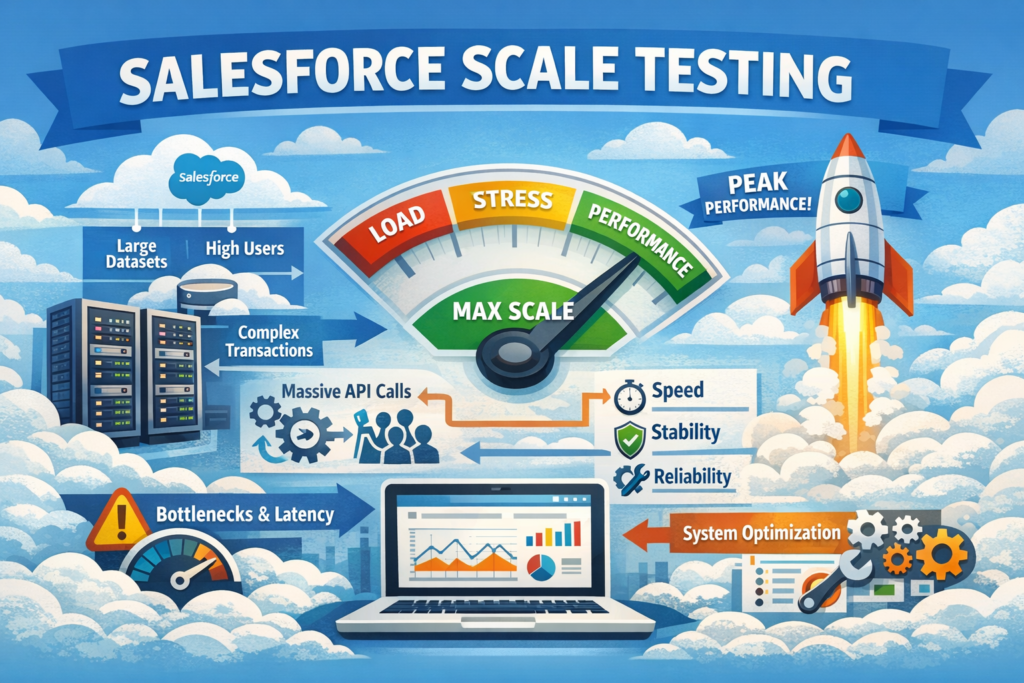
As companies grow, their Salesforce systems also grow. More customers, more users, more transactions, and more data start flowing into the platform. While this growth is a good sign for any business, it also creates a new challenge — maintaining performance when the system is under pressure.
If Salesforce is not prepared to handle a sudden spike in users or data processing, it can lead to slow performance, system delays, or even downtime. This is where Salesforce Scale Testing becomes extremely important.
Scale testing helps organizations evaluate whether their Salesforce environment can handle heavy workloads without affecting the user experience. It allows teams to identify performance problems before they affect real users.
In this article, we will understand what Salesforce Scale Testing is, why it matters for businesses, how it works, and what limitations organizations should consider before using it.
Understanding Salesforce Scale Testing
Salesforce Scale Testing is a process used to evaluate how a Salesforce application performs when the system experiences a large number of users, transactions, or data operations at the same time.
In simple terms, it recreates real-life high-traffic situations in a controlled environment. The system is tested under heavy load to see how it behaves and whether it continues to perform efficiently.
For example, businesses may experience heavy system usage during:
-
Product launches
-
Seasonal sales or promotional campaigns
-
Large marketing events
-
Major application rollouts
-
New feature deployments
During these situations, thousands of users might interact with Salesforce simultaneously. Without proper testing, such traffic spikes can slow down the system or cause failures.
Scale testing helps organizations prepare for these situations in advance.
Why Salesforce Scale Testing Is Important
In today’s competitive digital environment, system performance directly impacts customer experience and employee productivity. A slow or unstable system can lead to lost opportunities, reduced efficiency, and frustrated users.
Salesforce Scale Testing allows businesses to simulate heavy system usage before it actually happens. This helps technical teams understand how their Salesforce implementation behaves under pressure.
Some key benefits of scale testing include:
1. Identifying Performance Bottlenecks
Large Salesforce implementations often include complex automation, integrations, and custom code. These components can slow down system performance when traffic increases.
Scale testing helps identify slow processes, inefficient code, or overloaded components.
2. Preparing for Traffic Surges
Events like marketing campaigns or product launches can cause sudden increases in user activity. Testing the system beforehand ensures it can handle these situations smoothly.
3. Improving Application Stability
By running tests under simulated high load conditions, teams can detect potential failures and resolve them early.
4. Monitoring System Usage
Scale testing also provides valuable insights about system activity, such as:
-
Most frequently used pages
-
Slow-performing Lightning components
-
Most commonly used APIs
-
Backend processing times
These insights help organizations optimize their Salesforce architecture.
Continuous Optimization Through Scale Testing
Another advantage of scale testing is that it supports continuous improvement.
Instead of performing performance testing once, organizations can include it as part of their regular development cycle.
This allows teams to:
-
Improve testing strategies based on results
-
Discover new usage patterns and user behaviours
-
Test specific scenarios where traffic spikes occur
-
Monitor system performance trends over time
By continuously testing and optimizing the system, businesses can ensure Salesforce remains stable even as their operations expand.
How Salesforce Scale Testing Works
Salesforce provides a structured process for conducting scale tests. Each step is designed to ensure accurate testing and meaningful results.
Below are the key stages involved in the scale testing process.
1. Creating a Test Plan
A well-prepared test plan is the foundation of successful scale testing. Before starting the test, organizations need to clearly define what they want to measure and validate.
Important elements of a scale test plan include:
-
Identifying critical business processes to test
-
Defining test scenarios and expected user actions
-
Determining performance metrics to track
-
Estimating system throughput and response times
Performance metrics may include:
-
Page load speed
-
API response time
-
Backend processing time
-
Database operations
Tools can also be used to simulate real user behaviour and generate large volumes of test data.
A detailed test plan ensures the testing process delivers meaningful insights.
2. Setting Up the Test Environment
The next step is preparing the testing environment.
Salesforce scale testing is usually conducted in a Full Copy Sandbox, which closely resembles the production environment. This ensures that testing conditions reflect real-world system behaviour.
Before running the actual test, teams often perform trial runs to validate their setup.
Salesforce also provides a Trial Accuracy Checker, which helps evaluate how closely the sandbox environment matches the production system.
The results are displayed using three indicators:
-
Green – The environment accurately reflects expected traffic conditions
-
Yellow – Some improvements are required
-
Red – The environment does not match production and needs adjustment
Ensuring the environment closely resembles production is essential for reliable results.
3. Scheduling the Test
Salesforce Scale Test uses a scheduling system where organizations reserve time slots to perform their tests.
The booking process typically involves the following steps:
-
Go to Salesforce Setup
-
Search for the Scale Test Scheduler
-
Create a new booking request
-
Select available start and end dates
Once the booking is confirmed, the test is scheduled for execution.
Salesforce also allows users to monitor the status of their tests, which may include:
-
Completed tests
-
Upcoming scheduled tests
-
Currently running tests
If required, bookings can be cancelled before the scheduled date.
4. Running the Test and Analyzing Results
Once the test begins, Salesforce simulates large volumes of system activity.
During this process, various performance metrics are captured, including backend operations and system workload.
Some of the key metrics collected during scale testing include:
-
Trigger executions
-
Platform event processing
-
Database operations (DML)
-
API request performance
After the test is completed, teams analyze the collected data to identify performance issues.
Based on the insights, developers and administrators can optimize the system by improving code, redesigning processes, or adjusting configurations.
This process ensures that the Salesforce system becomes more efficient with each testing cycle.
Limitations of Salesforce Scale Testing
Although scale testing provides valuable insights, it also has certain limitations that organizations should consider.
Paid Feature
Salesforce Scale Test is not available by default. It is a paid add-on that requires additional licensing.
Requires Full Copy Sandbox
Organizations must have a Full Copy Sandbox to perform scale testing, which may not be available in all environments.
Shared Testing Environment
The testing environment is not completely isolated. Multiple customers may run tests within the same instance.
Data Collection Delay
Telemetry data collection begins after the first test run and may take a few days to fully populate.
Request Limits
Salesforce enforces request limits during scale testing. For example, the system allows a limited number of user logins per minute.
These limitations do not reduce the value of scale testing but should be considered during planning.
Final Thoughts
As businesses continue to scale their operations, ensuring system performance becomes increasingly important.
Salesforce Scale Testing provides organizations with a structured way to evaluate how their applications perform under heavy workloads. By simulating peak traffic conditions, businesses can identify performance bottlenecks, optimize system architecture, and prevent failures before they affect users.
Although it requires additional setup and licensing, the insights gained from scale testing can significantly improve system reliability and user experience.
Organizations that include scale testing as part of their development and release strategy are better prepared to handle growth, maintain system stability, and deliver consistent performance.
In a rapidly evolving digital landscape, proactive performance testing is no longer optional. It is an essential practice for maintaining a strong and scalable Salesforce ecosystem.