
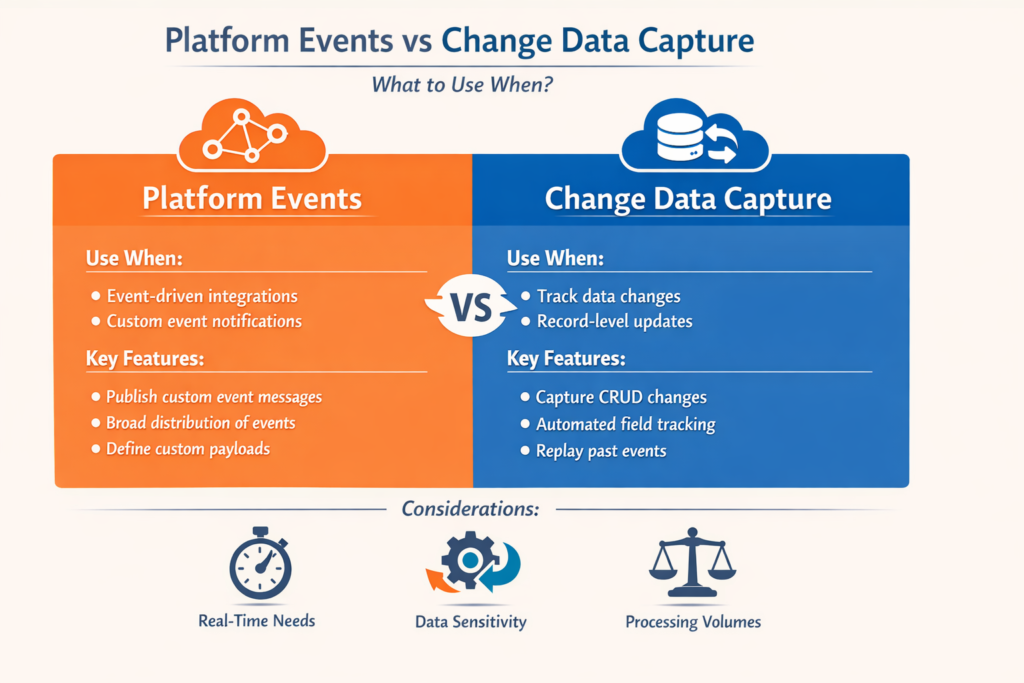
If you are working in Salesforce and stepping into integrations or real-time architecture, you’ve probably heard two terms again and again:
Platform Events and Change Data Capture (CDC).
At first glance, both look similar. Both are event-driven. Both support real-time integration. Both are powerful.
But here’s the real question:
When should you use Platform Events? And when is Change Data Capture the better choice?
In this detailed guide, I’ll explain everything in simple English, step by step — so you can confidently choose the right one for your project.
First, Let’s Understand Event-Driven Architecture
Before jumping into the comparison, let’s understand the concept.
In traditional systems:
-
System A calls System B.
-
System B responds.
-
Everything is tightly connected.
In event-driven architecture:
-
Something happens.
-
An event is published.
-
Any system interested in that event can react.
Salesforce supports event-driven integration using:
-
Salesforce Platform Events
-
Salesforce Change Data Capture
Now let’s understand them properly.
What Are Platform Events?
Platform Events are custom event messages that you define and publish in Salesforce.
Think of them like a notification system.
Example:
-
A payment is completed.
-
A lead becomes qualified.
-
An order is shipped.
Instead of directly calling another system, you publish a Platform Event. Any system subscribed to that event gets notified.
Key Characteristics of Platform Events
-
Custom-defined event structure
-
Real-time publishing
-
Can be triggered from Apex, Flow, or external systems
-
Useful for system-to-system communication
-
Event message exists for a limited retention time
Simple Example of Platform Events
Imagine you have:
Salesforce + Payment Gateway + ERP
When payment is successful:
-
Salesforce publishes a “Payment_Success_Event”.
-
ERP system listens to that event.
-
ERP automatically updates order status.
No direct API call needed. Clean. Scalable. Decoupled.
What Is Change Data Capture (CDC)?
Change Data Capture automatically publishes events whenever Salesforce data changes.
You don’t create custom events manually. Salesforce tracks changes for you.
Whenever a record is:
-
Created
-
Updated
-
Deleted
-
Undeleted
Salesforce sends an event notification.
Key Characteristics of Change Data Capture
-
Automatic event generation
-
Tracks record-level changes
-
No custom event definition required
-
Includes old and new field values
-
Great for syncing data with external systems
Simple Example of Change Data Capture
Suppose:
You want to sync Salesforce Accounts with a Data Warehouse.
Whenever:
-
Account is updated
-
Address changes
-
Status changes
CDC automatically sends the change event to the external system.
No need to write custom logic to publish events.
Platform Events vs Change Data Capture – Core Difference
Let’s simplify it.
| Feature | Platform Events | Change Data Capture |
|---|---|---|
| Who defines event? | You define it | Salesforce auto-generates |
| Triggered by | Custom business logic | Data changes |
| Use case | Business process events | Data synchronization |
| Custom fields? | Yes | Based on object fields |
| Manual publishing? | Yes | No |
Now let’s go deeper.
When to Use Platform Events?
Use Platform Events when:
1. You Need Custom Business Events
Example:
-
“Invoice Approved”
-
“Subscription Expired”
-
“Order Shipped”
These are business-driven events, not just data changes.
2. You Want Controlled Publishing
You decide exactly:
-
When the event fires
-
What data to include
-
Which system listens
3. You Need Decoupled Microservices Architecture
In modern enterprise systems, decoupling is critical.
Platform Events help systems communicate without direct dependency.
4. You Want Internal Salesforce Event Handling
Platform Events can trigger:
-
Apex triggers
-
Flows
-
External subscribers
Useful for advanced automation.
When to Use Change Data Capture?
Use CDC when:
1. You Need Real-Time Data Sync
If your goal is:
“Whenever record changes, update external system.”
CDC is perfect.
2. You Want Automatic Change Tracking
You don’t want to write:
-
Apex triggers
-
Custom publish logic
CDC handles everything automatically.
3. You Need Field-Level Change Information
CDC includes:
-
Changed fields
-
Old values
-
New values
-
Transaction metadata
Very useful for data warehousing and audit systems.
Real-World Use Case Comparison
Let’s say you are building an integration for an eCommerce system.
Scenario 1:
When Order is Shipped → Notify Logistics System
Use: Platform Events
Reason: It’s a business event.
Scenario 2:
When Account Address Changes → Update ERP
Use: Change Data Capture
Reason: It’s data synchronization.
Performance & Scalability Considerations
Both Platform Events and CDC are designed for high-volume enterprise use.
However:
-
CDC is optimized for object data changes.
-
Platform Events are better for business-driven messaging.
Always evaluate:
-
Event volume
-
Subscriber count
-
Transaction size
-
Retention requirements
Common Mistakes to Avoid
-
Using Platform Events just for simple data sync.
-
Using CDC when you actually need custom business logic.
-
Not considering event volume limits.
-
Ignoring replay and retention strategy.
Architectural clarity matters.
Which One Is Better?
This is the wrong question.
The right question is:
What is your use case?
-
Business workflow communication → Platform Events
-
Data change tracking & synchronization → Change Data Capture
In many enterprise architectures, both are used together.
SEO Summary Keywords
If you are learning or writing about this topic, important keywords include:
-
Salesforce Platform Events
-
Change Data Capture in Salesforce
-
Salesforce Event-Driven Architecture
-
Salesforce Integration Patterns
-
Real-Time Integration in Salesforce
These are high-demand topics in the Salesforce ecosystem right now.
Final Thoughts
Understanding the difference between Platform Events and Change Data Capture is essential if you want to move from basic Salesforce development to integration architecture.
Think like an architect:
-
Are you tracking data changes?
-
Or are you broadcasting business events?
Once you answer that clearly, the choice becomes simple.