
In today’s fast-moving business environment, companies need smarter ways to manage pricing, quoting, contracts, and revenue. If you work with Salesforce or are exploring its ecosystem, you’ve likely come across Salesforce CPQ and Revenue Cloud.
Many people assume these terms mean the same thing. In reality, they serve different purposes.
Let’s understand the difference in simple terms.
What is Salesforce CPQ?
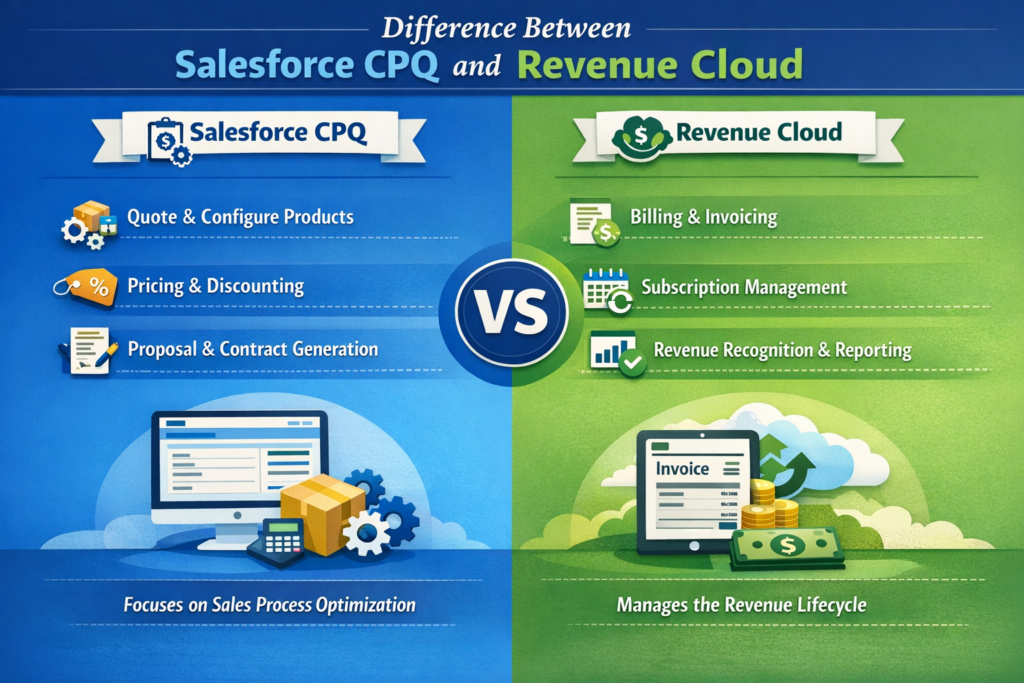
Salesforce CPQ (Configure, Price, Quote) is a solution designed to help sales teams generate accurate quotes quickly and efficiently.
It primarily focuses on:
-
Product configuration
-
Pricing and discounts
-
Quote generation
Salesforce CPQ reduces manual effort, minimizes pricing errors, and enables sales representatives to handle complex product structures with ease.
Example
Consider a business selling products with multiple options, bundles, or subscription variations. Salesforce CPQ ensures that sales teams configure the right combination and produce precise quotes without relying on spreadsheets.
What is Salesforce Revenue Cloud?
Revenue Cloud is a broader platform that extends beyond quoting. While it includes CPQ capabilities, it manages the entire revenue lifecycle.
Revenue Cloud typically covers:
-
Quoting (via CPQ functionality)
-
Contract management
-
Subscription lifecycle management
-
Billing and invoicing
-
Revenue recognition
In simple terms:
Salesforce CPQ helps create deals.
Revenue Cloud helps manage everything after the deal is created.
Key Difference: Scope of Functionality
The most important difference lies in how much of the business process each solution handles.
| Feature | Salesforce CPQ | Revenue Cloud |
|---|---|---|
| Product Configuration | Yes | Yes |
| Pricing & Discounts | Yes | Yes |
| Quote Generation | Yes | Yes |
| Contract Management | No | Yes |
| Subscription Lifecycle | No | Yes |
| Billing & Invoicing | No | Yes |
| Revenue Recognition | No | Yes |
Salesforce CPQ is primarily a sales-focused solution.
Revenue Cloud is a complete revenue management solution.
When Should You Use Salesforce CPQ?
Salesforce CPQ is suitable when:
-
Your primary challenge is generating accurate quotes
-
You deal with complex pricing models
-
Billing is managed outside Salesforce
-
You want to improve sales efficiency
It is commonly used by sales teams and businesses with configurable or bundled products.
When Should You Use Revenue Cloud?
Revenue Cloud is a better fit when:
-
Your business runs on subscriptions
-
You need billing within Salesforce
-
You manage renewals, amendments, and upgrades
-
You want an end-to-end revenue system
It is widely adopted by SaaS companies, subscription-based businesses, and enterprises seeking unified sales and financial operations.
A Simple Way to Understand the Difference
Think of Salesforce CPQ as a specialized tool for building and pricing deals.
Revenue Cloud acts as a comprehensive system that governs quoting, contracts, billing, and revenue tracking.
CPQ focuses on deal creation.
Revenue Cloud focuses on deal lifecycle management.
Why This Difference Matters for Businesses
Choosing between Salesforce CPQ and Revenue Cloud impacts:
-
Sales productivity
-
Billing accuracy
-
Customer lifecycle management
-
Financial visibility
Organizations that only need quoting capabilities may find CPQ sufficient.
Businesses requiring integrated billing, subscription management, and revenue processes benefit more from Revenue Cloud.
Common Business Scenario
Imagine a company offering:
-
Annual subscriptions
-
Mid-term upgrades
-
Usage-based pricing
-
Automated invoicing
Using only Salesforce CPQ may require separate billing tools.
Revenue Cloud enables businesses to manage the entire process within Salesforce.
Final Thoughts
Salesforce CPQ and Revenue Cloud are not competing products. Instead, they address different levels of business needs.
Salesforce CPQ focuses on configuring, pricing, and quoting.
Revenue Cloud focuses on managing the full revenue journey.
The right choice depends on your business model, operational complexity, and long-term strategy.