
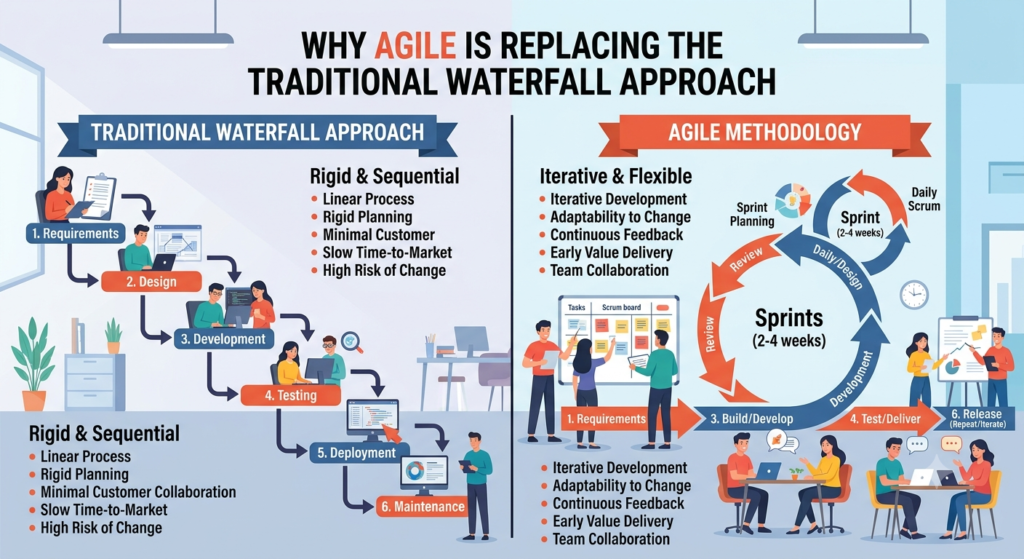
Software development has changed a lot over the years. Businesses today want faster delivery, better quality, and the flexibility to adapt when customer needs change. This is one of the biggest reasons why Agile has become more popular than the traditional Waterfall approach.
If you are new to software development or project management, don’t worry. In this article, we’ll explain everything in simple words so you can easily understand why companies around the world are choosing Agile over Waterfall.
What is the Waterfall Model?
The Waterfall model is one of the oldest ways to manage software projects. It follows a step-by-step process where each phase must be completed before moving to the next one.
The typical stages are:
- Requirement Gathering
- Planning
- Design
- Development
- Testing
- Deployment
- Maintenance
Think of it like building a house.
First, you prepare the design.
Then you build the foundation.
After that, you construct the walls.
Finally, you paint and decorate.
Once one stage is finished, going back is difficult and often expensive.
Example
Imagine a company wants to build an online shopping website.
They spend two months collecting requirements and another four months developing the entire website. After six months, the client realizes they also want a loyalty rewards feature.
In the Waterfall model, adding this new feature can require redesigning several parts of the system, increasing both time and cost.
What is Agile?
Agile is a modern way of developing software where work is completed in small parts instead of building everything at once.
Instead of waiting six months to see the final product, customers receive working features every few weeks.
This helps businesses:
- Get results faster
- Give feedback early
- Make changes whenever needed
- Reduce development risks
Agile focuses on continuous improvement rather than following a fixed plan.
Understanding Agile with a Simple Example
Suppose you want to build a food delivery app.
Instead of creating the entire application first, the Agile team builds it step by step.
Sprint 1
- User Registration
- Login
- Home Screen
The customer checks these features and shares feedback.
Sprint 2
- Restaurant List
- Food Menu
- Search Feature
Again, feedback is collected.
Sprint 3
- Cart
- Payment
- Order Tracking
By the end of a few weeks, customers are already using important parts of the application.
This approach allows developers to improve the product continuously.
Why Businesses Are Moving Towards Agile
Let’s understand the main reasons.
1. Customer Requirements Keep Changing
Today’s business environment changes very quickly.
Customers often come up with new ideas after seeing the product.
In the Waterfall model, these changes become difficult because everything has already been planned.
Agile welcomes changes, even during development.
This makes customers happier because they receive a product that actually meets their needs.
2. Faster Delivery
One of the biggest advantages of Agile is speed.
Instead of waiting months for the complete application, businesses receive working software every few weeks.
This helps companies launch products earlier and start getting customer feedback much sooner.
3. Better Customer Involvement
In Waterfall projects, customers usually see the product only near the end.
If something is wrong, fixing it can take a lot of time.
Agile keeps customers involved throughout the project.
Regular meetings and demonstrations ensure everyone stays on the same page.
4. Lower Risk
Imagine working on a project for one year only to discover at the end that customers don’t like it.
That’s a huge risk.
Agile reduces this risk by testing and reviewing the product continuously.
Problems are identified early when they are easier and less expensive to fix.
5. Higher Software Quality
Testing in Agile happens throughout the development process.
Developers fix bugs regularly instead of waiting until the project is almost complete.
As a result, the final software is usually more reliable and stable.
6. Better Team Collaboration
Agile encourages developers, testers, designers, and business teams to work together every day.
Instead of working separately, everyone shares updates, discusses challenges, and solves problems together.
This improves communication and reduces misunderstandings.
7. Continuous Improvement
At the end of every sprint, the team discusses:
- What went well?
- What problems occurred?
- What can be improved?
This habit helps teams become more productive with every sprint.
Waterfall vs Agile
| Waterfall | Agile |
|---|---|
| Fixed requirements | Requirements can change |
| Entire project delivered at the end | Small working features delivered regularly |
| Customer involvement is limited | Customer participates throughout the project |
| Testing happens after development | Testing happens continuously |
| Difficult to make changes | Easy to adapt to changes |
| Higher risk if requirements are incorrect | Lower risk through regular feedback |
Does This Mean Waterfall Is Bad?
Not at all.
Waterfall still works well for projects where requirements are very clear and unlikely to change.
For example:
- Government projects
- Construction projects
- Manufacturing systems
- Projects with strict legal regulations
In these cases, careful planning is often more important than flexibility.
When Should You Choose Agile?
Agile is a great choice when:
- Requirements may change frequently
- Customers want regular updates
- Fast delivery is important
- The project is large and complex
- Innovation and experimentation are encouraged
Most software companies, startups, and technology businesses use Agile because it allows them to respond quickly to market changes.
Popular Agile Frameworks
Agile is a mindset, and there are several frameworks that help teams apply it effectively.
Some of the most popular ones are:
- Scrum
- Kanban
- Extreme Programming (XP)
- Lean Software Development
- SAFe (Scaled Agile Framework)
Among these, Scrum is the most widely used because it is easy to understand and works well for many types of software projects.
Challenges of Agile
Although Agile has many benefits, it also comes with some challenges.
Some common ones include:
- Teams need good communication.
- Customers should be available to provide regular feedback.
- Proper planning is still necessary.
- Team members must be willing to adapt to changes.
- Without clear priorities, projects can lose focus.
When implemented correctly, these challenges can be managed successfully.
Why Agile Is the Future
Technology is evolving faster than ever.
Businesses launch new products, update existing features, and respond to customer feedback almost every day.
A development approach that allows quick changes and continuous improvement naturally becomes the preferred choice.
Agile supports this way of working by helping teams deliver value faster, reduce risks, and build products that better meet customer expectations.
That’s why companies ranging from startups to global enterprises have adopted Agile as their preferred project management methodology.
Final Thoughts
Agile is replacing the traditional Waterfall approach because it matches the needs of today’s fast-moving business world. Instead of waiting months for a finished product, companies can deliver working features quickly, gather feedback, and improve continuously.
This doesn’t mean Waterfall has become outdated. It still has its place in projects where requirements are fixed and changes are minimal. However, for most modern software development projects, Agile offers greater flexibility, better collaboration, and faster delivery.
If you’re beginning your journey in software development or project management, understanding Agile is an excellent first step. It’s more than just a process—it’s a way of working that focuses on teamwork, customer satisfaction, and continuous improvement.
As technology continues to evolve, Agile will remain one of the most valuable approaches for building software that truly meets user needs.