
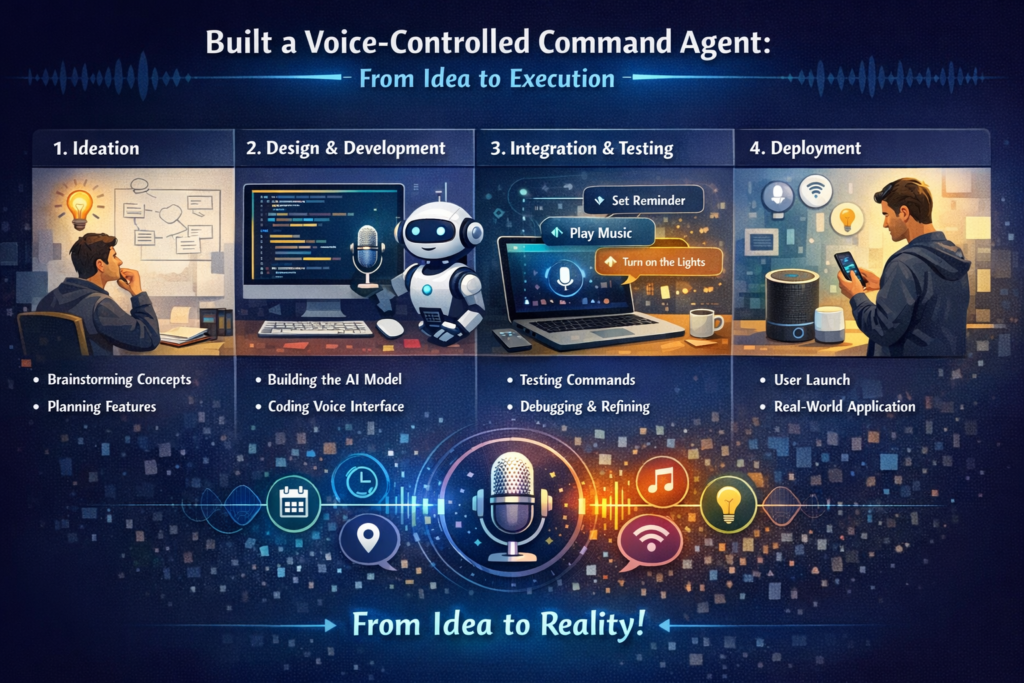
Built a Voice-Controlled Command Agent: From Idea to Execution
Voice technology is no longer limited to smart speakers or virtual assistants like Alexa and Siri. Today, developers and creators are building custom voice-controlled systems that can understand commands and perform actions in real time. One such innovation is a Voice-Controlled Command Agent.
In this blog, I’ll walk through what a voice-controlled command agent is, why it matters, how it works, and what I learned while building one. This is not just a technical explanation, but a real creator’s experience of turning an idea into a working system.
What Is a Voice-Controlled Command Agent?
A voice-controlled command agent is a system that listens to spoken input, understands the intent behind it, and executes a specific command.
For example:
-
“Open the browser”
-
“Run the data sync process”
-
“Send a report to the admin”
-
“Start the server”
Instead of typing commands or clicking buttons, the user simply speaks. The agent processes the voice input and performs the required action automatically.
Why Build a Voice-Controlled Agent?
The main motivation behind building this agent was simplicity and speed. Typing commands or navigating through multiple screens takes time. Voice interaction removes friction.
Key reasons why voice-controlled agents are powerful:
-
Hands-free operation
-
Faster execution of repetitive tasks
-
Better accessibility for users
-
More natural human-computer interaction
-
Improved productivity
This kind of system is especially useful in development environments, admin dashboards, smart devices, and automation tools.
How the Voice-Controlled Command Agent Works
The system is built in a step-by-step flow. Each part plays a critical role.
1. Voice Input Capture
The agent first listens to the user’s voice using a microphone. This is the starting point of the entire process.
2. Speech-to-Text Conversion
The spoken words are converted into text using a speech recognition engine. Accuracy here is important because the next steps depend entirely on the converted text.
3. Intent Recognition
Once the text is available, the system analyzes it to understand the intent.
For example:
-
“Open Chrome” → open application
-
“Run backup” → execute script
-
“Shutdown system” → system command
This step decides what action needs to be performed.
4. Command Mapping
Each recognized intent is mapped to a predefined command or function. This ensures that only allowed and safe commands are executed.
5. Command Execution
The agent executes the mapped command and performs the task.
6. Feedback to User
After execution, the agent provides feedback, either through voice or text, confirming whether the command was successful.
Challenges Faced While Building It
Building a voice-controlled system is exciting, but it comes with real challenges.
Accuracy of Voice Recognition
Background noise, accents, and pronunciation variations can affect recognition. Handling these cases required fine-tuning and testing.
Command Safety
Allowing voice commands to control systems can be risky. I had to ensure:
-
Only predefined commands are allowed
-
No harmful or unauthorized actions can be triggered
-
Proper validation before execution
Response Time
The system needed to respond quickly. Any delay between voice input and execution breaks the experience.
Error Handling
When a command is not recognized, the agent must respond politely and guide the user instead of failing silently.
Real-World Use Cases
A voice-controlled command agent can be used in many real scenarios:
-
Developer tools for running scripts and builds
-
Smart office automation
-
Admin systems for monitoring and control
-
Accessibility tools for users with physical limitations
-
Customer support automation
-
Smart home or IoT systems
The possibilities grow as voice recognition and AI improve.
SEO Perspective: Why This Topic Matters
From an SEO point of view, voice-controlled systems are highly relevant because:
-
Voice search is increasing rapidly
-
Users search for automation and AI-based solutions
-
Keywords like “voice-controlled agent”, “AI command system”, and “speech-based automation” have growing interest
Writing about real implementation experiences adds authenticity, which search engines value more than generic content.
SMO Angle: Why People Share This Content
Content like this performs well on social media because:
-
It talks about real innovation
-
It shows practical implementation, not just theory
-
It appeals to developers, tech leaders, and AI enthusiasts
-
It sparks curiosity about future technology
Sharing real build experiences builds credibility and personal branding.
What I Learned From This Project
Building a voice-controlled command agent taught me important lessons:
-
Simple ideas can create powerful solutions
-
User experience matters more than complexity
-
Security should never be an afterthought
-
Voice is becoming a primary interface, not a secondary one
Most importantly, it reinforced the idea that AI and automation are not just trends, they are tools to solve real problems.
Final Thoughts
A voice-controlled command agent is more than just a technical experiment. It is a step toward more natural and efficient interaction between humans and machines.
As voice technology continues to evolve, systems like these will become common across industries. Building one today not only improves technical skills but also prepares us for the future of intelligent automation.
If you are thinking about building something innovative, start simple. Sometimes, a voice command is all it takes to change how we work.
as I website owner I believe the content here is very fantastic, thanks for your efforts.
This is very interesting, You’re a very skilled blogger. I have joined your feed and look forward to seeking more of your great post. Also, I have shared your website in my social networks!